🇮🇩 Indonesia · Island of the Gods · 4 Hours from Brisbane

The Island of
the Gods.
Bali.

Twenty thousand temples on a single island the size of Kangaroo Island. Rice terraces plunging from volcanic highlands to the Indian Ocean in twenty shades of green. A Kecak fire dance performed on a clifftop above crashing waves at sunset. And Ubud — the most spiritually concentrated small city in Southeast Asia — four hours from Brisbane by direct flight.

20,000+
Hindu Temples on One Island
1,717m
Mount Agung · Active Volcano
4 hrs
Direct Flight from Brisbane
5,780 km²
Island Area (size of Kangaroo Island)
1972
Kecak Fire Dance Created · Ubud
🏖 Bali Guide
Island of the Gods

Bali — The World’s Most
Spiritually Dense Small Island

Bali (population 4.3 million — an island of 5,780 km² in the Indonesian archipelago, positioned at the narrow strait between Java to the west and Lombok to the east — the geographical point where the Wallace Line passes, the biogeographic boundary separating the flora and fauna of Asia from Australasia) is the only Hindu-majority island in an otherwise Muslim Indonesia, and its Balinese Hinduism — a distinctly local synthesis of Indian Hindu traditions, Javanese influences, and the indigenous animist beliefs that predate both — is woven into every aspect of daily life at a density that has no equivalent in Southeast Asia. The 20,000+ temples (pura) — not ancient ruins but actively used ceremonial sites where the Balinese community gathers for the cycle of odalan festivals (each temple celebrates its own anniversary every 210 days on the Balinese Pawukon calendar — with more than 20,000 temples on the island, a temple festival is occurring somewhere in Bali on every single day of the year) — the morning canang sari offerings (woven palm-leaf baskets of flowers, incense, rice, and snacks that Balinese women place at doorways, on streets, at temple shrines, on dashboards, and at business entrances every morning — approximately 4.5 million individual offerings placed per day across the island), and the cultural calendar of dance, music, and ceremony collectively make Bali the most spiritually legible landscape in Southeast Asia.

The island divides into sharply distinct character zones. Ubud (the cultural capital — 25km inland, 300m above sea level — the rice terraces, the art galleries, the Monkey Forest, the Tegallalang rice paddies, the palace, the morning market) is the Bali that travellers who have been before always return to. Seminyak and Canggu (the beach resort strip north of Kuta — beach clubs, surf breaks, the boutique hotel and restaurant density that defines Bali’s contemporary hospitality character) serve the rest. Uluwatu (the Bukit Peninsula’s clifftop at the island’s southern extreme — the Pura Luhur Uluwatu temple on a 70-metre cliff above the Indian Ocean, the Kecak fire dance performed on a clifftop stage every evening at sunset) is the single most cinematically dramatic experience on the island. The Nusa Islands (Nusa Penida, Nusa Lembongan, Nusa Ceningan — accessible by fast boat from Sanur in 45 minutes) offer the Bali coast that the main island’s development has largely obscured: turquoise water, Manta Point’s oceanic manta rays, and Kelingking Beach’s iconic dinosaur-head cliff.

✅ Bali Practical Essentials
  • Visa: Visa on Arrival for Australian passport holders — IDR 500,000 (~AUD$50) — obtained at Ngurah Rai International Airport on arrival. Alternatively, the eVisa is available at molina.imigrasi.go.id before departure.
  • Currency: Indonesian Rupiah (IDR) — approximately IDR 10,000 = AUD $1. ATMs widely available in tourist areas; use BCA, BNI, or Mandiri ATMs for the best rates and lowest fees. Do not exchange currency at airport kiosks — use authorised money changers in Kuta or Seminyak (PT Dirgahayu is the most trusted chain) for cash rates.
  • Transport: Hire a driver (IDR 600,000–800,000 per day — approximately AUD $60–80 — the single most cost-effective way to explore the island; most Balinese drivers speak functional English and provide genuine local knowledge beyond any app). Grab (Southeast Asia’s Uber) is now operational in Bali and provides metered pricing from the airport and between tourist areas. Note: Grab is technically not permitted to pick up at certain hotel entrances due to local taxi union agreements — walk 50 metres from the entrance.
  • Electrical: Indonesia uses Type C and F plugs (European 2-pin) at 220V/50Hz — bring an adaptor. Australian plugs (Type I) do not fit without one.
  • Temple etiquette: A sarong and selendang (sash) are required to enter any Balinese temple — rentals available at every major temple entrance for IDR 10,000–20,000. Cover shoulders and knees. Do not enter temples if menstruating (the Balinese belief that menstruation creates an impure state — there will be signage at the entrance; it is not negotiable).
Six Distinct Zones

Bali’s Key Regions

Bali rewards those who leave the beach strip — the island’s most compelling experiences are in the highlands, on the clifftops, and on the smaller islands offshore.
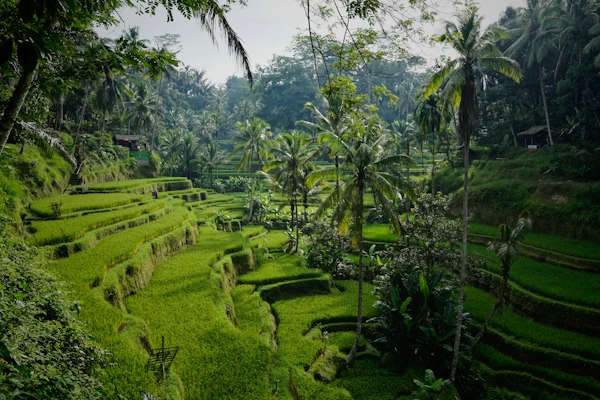
Ubud Bali rice terraces Tegallalang Monkey Forest
Ubud
🌿 Cultural Capital · 25km Inland

Ubud (the artists’ town at the geographic heart of Bali — surrounded by rice paddies on three sides, the Campuhan Ridge walk to the west, the Monkey Forest to the south, the Puri Saren Agung Royal Palace at the town’s centre) is the cultural capital of Bali and the destination that concentrates the island’s art, dance, spiritual activity, and culinary refinement. The Ubud Market (the morning market that occupies the crossroads in front of the palace — operates 6–10am for fresh produce and prepared food, transitioning to tourist craft stalls from 9am — the correct sequence is to arrive at 6:30am, eat nasi goreng from the warungs on the market’s eastern edge for IDR 15,000, watch the produce transactions, then browse the crafts before the tour buses arrive). The Tegallalang Rice Terraces (the most photographed rice terrace landscape in Bali — 15km north of Ubud — the Campuhan subak irrigation system dating to the 9th century, the rice in various stages of growth depending on the season — the most photogenic stage is the first two weeks after transplanting, when the paddies are filled with water and young rice shoots create a mirror-like surface at dawn). The Campuhan Ridge Walk (the 9km ridge track from Ubud town centre through coconut groves and small Hindu shrines to Kedewatan village — the correct Ubud experience for anyone who walks — depart before 7am to walk in the cool before the day’s heat).

  • Tegallalang Rice Terraces — subak irrigation since the 9th century
  • Campuhan Ridge Walk — 9km, depart before 7am
  • Ubud Market — 6am produce market, 9am craft stalls
  • Ubud Monkey Forest — 700+ long-tailed macaques, 3 temples
  • Puri Saren Agung Palace — nightly Kecak and Legong dance performances
  • Goa Gajah (Elephant Cave) — 9th-century meditation site, 2km from Ubud
Uluwatu temple Bali clifftop sunset Kecak fire dance
Uluwatu & the Bukit Peninsula
🏭 Clifftops · Kecak · Surf

The Bukit Peninsula (the limestone plateau forming Bali’s southern headland — from Jimbaran’s fish grills in the north to Uluwatu’s cliffs in the southwest) contains the island’s two most cinematically dramatic experiences. Pura Luhur Uluwatu (one of Bali’s six kayangan jagat directional temples — built on a 70-metre vertical limestone cliff above the Indian Ocean — the temple’s outer walls extend to the cliff edge, the sea churning 70 metres below — the monkeys that guard the temple are notorious bag and glasses thieves; do not carry anything you cannot lose — the Kecak fire dance performance on the clifftop stage, every evening at sunset, is the single most atmospheric cultural performance available to a visitor in Bali: 150 male voices providing the “cak” percussion, the Ramayana story enacted in the firelight, the Indian Ocean turning orange below the stage). Jimbaran seafood (the fish market and beach restaurants at Jimbaran Bay — the catch arrives at the market at 6am, the restaurants display the day’s whole fish, lobster, and seafood by the kilogram, grilled over coconut husks on tables set directly on the beach sand as the sun sets — the most authentically Balinese beach dining experience on the island). Padang Padang Beach, Bingin, and Balangan provide the Bukit’s surf breaks.

  • Pura Luhur Uluwatu — 70m cliff temple, Kecak fire dance every sunset
  • Kecak fire dance — 150-voice percussion, Ramayana story, clifftop stage
  • Jimbaran seafood — beach grills, whole fish by kg, sunset dining
  • Padang Padang — sheltered beach, featured in Eat Pray Love
  • Bingin Beach — the most beautiful small beach on the Bukit Peninsula
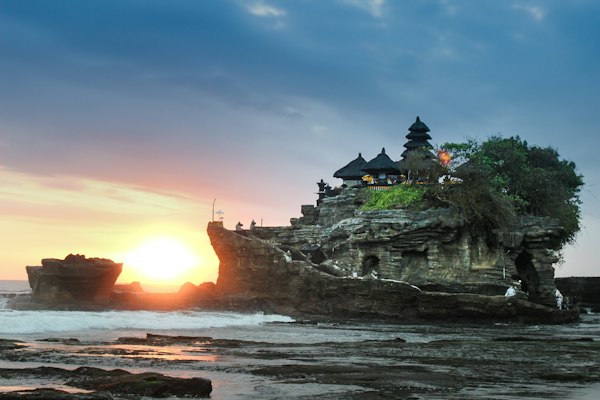
Tanah Lot temple Bali ocean sunset
Tanah Lot & West Bali
🌊 Sea Temple · Sunset Icon

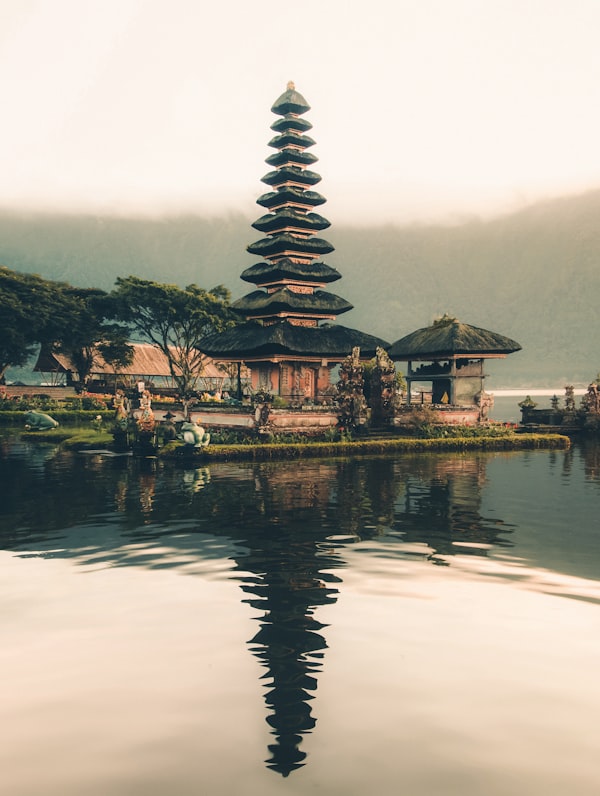
Tanah Lot (the sea temple on an offshore rock formation accessible at low tide by a causeway of volcanic stone — “Tanah Lot” means “Land in the Middle of the Sea” in Balinese — one of Bali’s most photographed landmarks, the temple’s silhouette against the setting sun behind the Indian Ocean producing the most reproduced photographic image associated with Bali — arrive 45 minutes before sunset, walk the causeway to the base of the rock before the tide comes in, and wait on the western-facing cliff for the light) is the western counterpart to Uluwatu’s clifftop drama. At low tide, the temple’s base is accessible and a holy sea snake emerges from the cave beneath the rock to bless worshippers (the black-and-white banded sea krait — genuinely venomous — the blessing interaction is handled by the temple’s priests, not by visitors). The road from Tanah Lot north to Tabanan and the Jatiluwih rice terraces (the UNESCO-listed subak irrigation terraces — larger and less commercial than Tegallalang, UNESCO-inscribed in 2012 specifically for the subak irrigation system that has maintained Bali’s rice agriculture for over a millennium) passes through the most intact Balinese agricultural landscape accessible by road.

  • Tanah Lot — sea temple on volcanic rock, sunset photography icon
  • Arrive 45 min before sunset — best position: western cliff above the rock
  • Jatiluwih Rice Terraces — UNESCO inscribed 2012 · less commercial than Tegallalang
  • Holy sea snake at Tanah Lot — black/white sea krait in the cave at low tide
  • Tabanan Regency — the most agricultural of Bali’s 9 regencies
Seminyak Canggu Bali beach clubs surf sunset
Seminyak, Kuta & Canggu
🏈 Beach · Surf · Nightlife

The beach strip (Kuta — the original 1970s backpacker destination, now the most commercially developed section of the island — Seminyak — the boutique hotel, restaurant, and beach club district immediately north of Kuta, the highest concentration of world-class independent restaurants in Bali — Canggu — the surf and digital nomad precinct 8km further north, the Echo Beach break, the Pererenan rice paddy cafés, the most photogenic sunset from the beach in the south Bali tourist zone) is where the majority of Bali’s international tourists stay, concentrated on a 12km beach strip between the airport and Canggu. Seminyak contains Bali’s finest independent restaurants: Sarong (progressive Asian in a heritage house), Metis (Mediterranean with French technique), Merah Putih (Indonesian regional cuisine in a 15-metre glass barrel vault — the most architecturally extraordinary restaurant interior in Bali). Potato Head Beach Club (Seminyak’s iconic beach club — the amphitheatre of recycled teak doors facing the sunset, the pool with its retaining wall of 3,000 antique teak window shutters — the most architecturally considered beach club in Bali — arrive at 4pm for the best sunset tables). The surf at Kuta and Canggu (the Kuta beach break is the most accessible beginner surf in Bali — consistent, warm, and crowded; Canggu’s Echo Beach is sharper and more appropriate for intermediate surfers) is the activity that anchors most Australian visitors’ time in the beach strip.

  • Potato Head Beach Club — arrive 4pm, teak door amphitheatre, sunset tables
  • Merah Putih restaurant — glass barrel vault, Indonesian regional cuisine
  • Kuta beach surf — beginner-friendly, consistent, warm water year-round
  • Echo Beach, Canggu — intermediate surf, sunset crowd, beach warungs
  • Seminyak Square and Eat Street — the boutique retail and restaurant spine
Nusa Penida Bali Kelingking Beach manta ray snorkelling
Nusa Islands
🌊 Nusa Penida · Manta Point · 45 min by boat

The Nusa Islands — Nusa Penida (the largest, 200 km², 45 minutes by fast boat from Sanur), Nusa Lembongan (the most accessible and most resort-developed, 30 minutes from Sanur), and Nusa Ceningan (a small island connected to Lembongan by a rickety yellow suspension bridge — the bridge is more memorable than anything on the island itself) — offer the Bali that the main island’s three decades of mass tourism have largely obscured: intact coral reefs, turquoise water with 20-metre visibility, and the island topography that the Balinese coast no longer provides. Manta Point (the oceanic manta ray (Manta birostris) cleaning station at the southwestern corner of Nusa Penida — 4–8 manta rays (wingspan 4–7 metres) regularly present at the cleaning station, approachable by snorkellers at 2–5 metres depth — the most reliably accessible manta ray encounter in Southeast Asia — currents can be strong: use a guided operator who monitors conditions). Kelingking Beach (the “T-Rex” headland on Nusa Penida’s western cliff — the limestone formation that from the lookout above resembles a dinosaur’s head, with a white sand beach at its feet accessible via a steep 30-minute descent — the most photographed single image from Bali in the Instagram era, recognisable without a caption to anyone who has seen a travel photograph of Indonesia in the last decade). Crystal Bay (snorkelling with Mola mola sunfish July–October — the world’s heaviest bony fish at up to 2,300kg — comes to the cleaning station at Crystal Bay from the deep ocean during the cold upwelling season).

  • Manta Point — oceanic mantas with 4–7m wingspan, year-round
  • Kelingking Beach — T-Rex limestone headland, 30-min steep descent
  • Crystal Bay — Mola mola sunfish, July–October
  • Fast boat from Sanur — 45 min to Nusa Penida, 30 min to Lembongan
  • Angel’s Billabong & Broken Beach — natural rock pool and sea arch
Mount Batur volcano sunrise trekking Kintamani Bali
Kintamani & the Volcanic Highlands
🌋 Mount Batur · Highlands · 1,717m Agung

The Batur volcanic caldera (the largest intact caldera in Bali — 11km across, the inner cone of Gunung Batur (1,717m) rising from the caldera floor, Lake Batur (the largest lake in Bali, 7.5km long) filling the caldera’s western section — the caldera rim road from Penelokan provides the finest single panoramic view of Bali’s volcanic interior from a sealed road) is the island’s most accessible volcanic landscape and the departure point for Bali’s most popular trekking experience: the Mount Batur sunrise trek (depart the base at 4am, reach the 1,717m summit at sunrise — approximately 2 hours uphill on loose volcanic scree and lava field — Grade 3 difficulty — the sunrise view from the crater rim across the inner lake and east toward Mount Agung and Lombok’s Rinjani beyond is the finest mountain view accessible to a visitor of ordinary fitness in Bali — the guide boils eggs in the volcanic steam vents at the crater rim, the most literally Balinese breakfast available). Tirta Empul (the holy spring water temple at Tampaksiring — the most visited of Bali’s major temples for active religious ceremony — Balinese Hindus queue to immerse themselves in the spring-fed purification pools, each pool’s spout with a specific spiritual function — visitors are welcome to participate, a sarong is provided). Kopi Luwak coffee plantations (the civet-processed coffee — the most famous and most frequently visited agricultural product in highland Bali — the ethical question around civet welfare is legitimate; seek out plantations with free-range civets).

  • Mount Batur sunrise trek — 4am departure, Grade 3, eggs in volcanic steam at summit
  • Caldera rim road from Penelokan — finest panoramic highland view
  • Tirta Empul holy spring — Balinese purification pools · most active temple ceremony
  • Tegallalang rice terraces — on the road back to Ubud from Kintamani
  • Kopi Luwak — seek free-range civet farms for ethical purchase
💡 INSIDER TIP — The Canang Sari Morning Offering

At 6–7am each morning, Balinese women place canang sari — small woven palm-leaf baskets containing flower petals, incense sticks, snacks, and rice — at every threshold, on every car dashboard, at every business entrance, and at every shrine on the island. Approximately 4.5 million individual offerings are placed every single day. The practice is not a tourist attraction; it is the daily renewal of the island’s spiritual contract between the Balinese people and their gods. If you walk through Ubud or any Balinese village at 6:30am, you will see this practice at its most unhurried and most sincere — the women moving quickly, the incense smoke still rising, the offerings placed with a precision that is entirely automatic from a lifetime of daily practice. This is the correct version of Bali. It costs nothing and requires only being awake early.

Why Bali Is Different

Most destinations have a spiritual dimension that tourists can observe at a respectful distance — a cathedral, a mosque, a monastery — and then leave. Bali is different because the spiritual life of the island is not contained in dedicated buildings that you visit and depart. It is distributed through the entire landscape, operating continuously, without an audience in mind. The canang sari offerings placed every morning. The odalan festivals cycling through 20,000 temples every 210 Balinese days. The sound of the gamelan orchestra carrying across the rice paddy at dusk from a ceremony no guidebook mentions. The temple in the rice paddy that the farmers walk past each morning on the way to irrigate.

“The spiritual life of Bali is not contained in buildings you visit. It is distributed through the entire landscape, operating continuously, without an audience in mind.”

This is why the travellers who love Bali most are not the ones who spent their time in the beach clubs of Seminyak — though those have their own pleasures — but the ones who hired a driver for two days and asked him to take them to the places he goes. Balinese drivers are not guides in the formal sense; they are community members who move through a landscape they understand at a cellular level. Ask your driver where his family’s temple is. Ask him what ceremony is happening in his village this week. Ask him to stop at the warung where he eats breakfast. This is not a travel hack. It is the correct way to receive what Bali is offering.

9 Curated Experiences

Bali Tours from Brisbane

Small-group experiences designed around what Bali does best — all bookable through Cooee Tours.

🌿 Ubud · Cultural
Ubud Cultural Full Day Tour
⏱ Full day★ 5.0(3,240 reviews)

The full Ubud circuit — the island’s cultural day done properly. Depart hotel 7:30am, arrive Ubud market by 8am (the produce market at its most alive — the morning transactions between farmers and warung owners — the guide navigating the crowd and explaining what each vendor is selling and why). Tegallalang Rice Terraces (15km north — the subak irrigation terraces with the guide explaining the 9th-century water management system and the UNESCO inscription that protects it — the terraces are most photogenic at 9–10am when the mist has lifted and the light is still oblique). Tirta Empul holy spring water temple (the most active Balinese purification ceremony visible to visitors — the spring-fed pools with the devotees immersing themselves — the guide provides the spiritual context for each pool’s function). Campuhan Ridge Walk afternoon (the 9km ridge from Ubud town — the guide leads the first 4km to the viewpoint and returns — or the full walk if the group prefers). Puri Saren Agung evening Kecak or Legong dance performance (nightly from 7:30pm — the traditional palace courtyard illuminated by flaming torches — book in advance at IDR 150,000 — the courtyard’s stone carvings and the dancers’ costumes in the torchlight make this the finest indoor-courtyard performance experience in Ubud).

Includes
Ubud morning marketTegallalang rice terracesTirta Empul templeCampuhan Ridge WalkEvening dance performance
⛿ Uluwatu · Sunset
Uluwatu Temple & Kecak Fire Dance Sunset
⏱ Half day (afternoon)★ 5.0(4,120 reviews)

The Uluwatu sunset Kecak is the single most atmospheric cultural experience available to a visitor in Bali — and the most consistently cited by travellers who have been to Bali multiple times as the experience they return to. Pura Luhur Uluwatu (the temple built on the cliff edge 70 metres above the Indian Ocean — walk the temple complex in the afternoon light as the monkeys perform their daily theft from distracted visitors — the guide’s warning about the monkeys is not precautionary but predictive: they will take sunglasses from your face if you are not paying attention — leave valuables at the hotel). The Kecak fire dance (the clifftop performance space carved into the natural rock above the ocean — 150 male voices providing the chanted “cak” percussion that simulates the monkey army of the Ramayana — no instruments, only voices and fire — the story of Prince Rama, the kidnapping of Sita by the demon king Ravana, and the liberation by Hanuman the monkey god, enacted in costume as the sun drops into the Indian Ocean behind the performers — the performance created by German artist Walter Spies and Balinese dancer Wayan Limbak in 1930 for a German ethnographic film, now performed nightly). Jimbaran beach seafood dinner (the fish market to the beach grill — the guide orders the day’s catch by weight at the market, the restaurant grills it over coconut husks on tables set in the sand at the water’s edge — the most authentic Balinese dining experience on the island).

Includes
Hotel transfersPura Luhur Uluwatu guided visitKecak fire dance ticketsJimbaran beach seafood dinner
⛿ Temples · UNESCO Rice
Tanah Lot Sunset & Jatiluwih Rice Terraces
⏱ Full day★ 4.9(2,680 reviews)

The western Bali circuit — the day that combines the island’s most iconic sunset photography location with the UNESCO-inscribed subak rice terraces that Jatiluwih represents at a larger and more undisturbed scale than Tegallalang. Jatiluwih (the 600-hectare UNESCO World Heritage rice terrace landscape — inscribed in 2012 specifically for the subak water management system — the terraces follow the natural contours of the Batukaru slopes at 700 metres, the rice at a cooler and slower-growing elevation than the southern terraces, the landscape less visited and more genuinely agricultural than Tegallalang — the trail through the terraces passes working farmers, ducks herded through the paddies to fertilise them, and the small water temples at each irrigation junction that reflect the spiritual governance of the subak system). Tanah Lot (the sea temple at sunset — arrive 1 hour before sunset, walk the causeway to the base of the rock before the tide comes in, the holy sea krait emerging from the cave beneath the temple at low tide to be blessed by the priests — the temple itself is not accessible to non-Balinese Hindus but the surrounding terraced cliff garden and the sunset position are the experience). The Balinese cooking class at a family compound near Tabanan (optional add-on — 2 hours, learn to make nasi goreng, mie goreng, and lawar — the Balinese minced meat and coconut dish that is the ceremonial food — and eat the results).

Includes
Hotel transfersJatiluwih UNESCO rice terracesTanah Lot at sunsetPura Taman Ayun royal temple
⛰ Adventure · Volcano
Mount Batur Sunrise Trek
⏱ Full day (depart 1am)★ 4.9(3,890 reviews)

The Mount Batur sunrise trek is Bali’s most popular active experience — and the one that most visitors retrospectively name as their best day on the island. The logistics require commitment: hotel pick-up between 1am–2am (depending on hotel location), drive to the Toya Bungkah base village (1.5–2 hours), begin the climb at 4am (the trail ascends through dense forest for the first 40 minutes, then transitions to open lava field — loose, dark volcanic scree with occasional fixed ropes on the steeper sections — Grade 3 — no technical climbing — any person of reasonable fitness who walks regularly can complete the ascent in 2–2.5 hours). The summit (1,717m) is reached at sunrise — the moment the sun emerges from behind Mount Agung (Bali’s highest and most sacred volcano, 3,031m, visible across the caldera to the southeast) and floods the caldera with horizontal golden light, the inner lake below turning from black to gold, is the specific visual experience the 4am departure is designed to produce. The guide cooks eggs in the volcanic steam vents on the crater rim — the most literally Balinese breakfast (everything in Bali is cooked by the landscape in one way or another) and a genuine delight. The descent (1.5 hours) returns to the base for a lakeside breakfast before the drive back. Optional extension: Kintamani caldera rim viewpoint and Tirta Empul temple on the return to the hotel.

Includes
Hotel return transfersCertified local guideVolcanic steam egg breakfastCrater rim sunrise viewCaldera viewpoint descent
🌊 Nusa Penida · Island
Nusa Penida Day Tour — Kelingking, Mantas & Angels
⏱ Full day from Sanur★ 4.9(2,340 reviews)

The Nusa Penida day tour (fast boat from Sanur — 45 minutes — book the 7:30am departure for the longest day on the island) is the single most diverse one-day experience available in the Bali region: the island’s extreme topography (vertical limestone cliffs, white sand beaches, turquoise water), its major natural features (Kelingking, Broken Beach, Angel’s Billabong), and its marine wildlife (Manta Point) all in a single departure. Manta Point (the oceanic manta ray cleaning station — depart Sanur early enough to arrive at Manta Point by 8:30am when the mantas are typically at their most active — 4–8 mantas with 3–6 metre wingspans — the snorkel guide positions the group at the correct depth and distance — the mantas are entirely unconcerned by human presence and will continue their barrel rolls through the plankton within arm’s reach). Kelingking Beach (the T-Rex headland — the lookout above the formation provides the famous photograph — the descent to the beach is optional, steep, 30 minutes each way — recommended in dry season only — the beach itself is small, sheltered, and strikingly beautiful but the crowds at the viewpoint are the main Nusa Penida reality in peak season — arrive before 9am). Angel’s Billabong (the natural rock pool at the island’s western edge — the pool connects to the ocean through a fissure in the rock — the clear water and the rock’s textured surface are the photographic draw — do not enter when swell is running, the surge through the fissure is extremely dangerous). Broken Beach (the natural sea arch 200 metres from Angel’s Billabong — an eagle ray is almost always visible in the lagoon from the arch).

Includes
Fast boat Sanur returnManta Point snorkellingKelingking Beach viewpointAngel’s BillabongBroken BeachSnorkel equipment
⛿ Temples · Full Day
Bali Sacred Temples Circuit
⏱ Full day★ 4.8(1,780 reviews)

Bali has six kayangan jagat — directional temples that protect the island from the six cardinal directions (and one at the centre) — and hundreds of additional pura desa (village temples), pura puseh (origin temples), and pura dalem (death temples) that each Balinese community maintains as its spiritual infrastructure. This full-day temple circuit visits four of the most significant: Pura Besakih (the “Mother Temple” at 1,000 metres on the slope of Mount Agung — the most important Hindu temple in Bali, a complex of 23 separate temples ascending the volcano’s lower flank, established c.1007 CE, the most visited temple on the island and the one requiring the most guide assistance to navigate without being attached to a “compulsory guide” at the entrance — our guide handles this and pre-pays the donations to avoid the scam), Pura Kehen (the state temple of Bangli — a terraced hillside temple whose 11-tiered meru (tower) is the most architecturally elaborate on the island outside Besakih — significantly fewer visitors than Besakih and more accessible as an active temple experience), Goa Gajah (the Elephant Cave near Ubud — a 9th-century rock-cut meditation cave whose mouth is carved into the face of a demonic figure — the bathing pools in the courtyard are active holy springs), and Pura Tirta Empul (the spring water purification pools — the most active living ceremony accessible to visitors).

Includes
Hotel transfersPura Besakih — Mother TemplePura Kehen — Bangli state templeGoa Gajah Elephant CaveTirta Empul holy springsSarong & sash provided
⛰ Adventure · River
Ayung River White Water Rafting
⏱ Half day★ 4.8(2,890 reviews)

The Ayung River (Bali’s longest river — flowing south from the Kintamani highlands through the Ubud gorge system to the coast at Sanur — the river at the rafting section between Sayan and Kedewatan is in a 60–80 metre deep gorge of carved sandstone whose walls are covered in hanging ferns, bamboo, and tropical fig trees — the gorge has been carved over 20+ million years and is invisible from any road) is the finest rafting environment in Bali, and the 12km Grade 2–3 section (suitable for first-timers — the rapids are exciting but not technical — no swimming ability required) passes through a landscape of extraordinary tropical density. The river-level perspective of the Balinese gorge is inaccessible by any other means: the overhanging tropical forest, the stone carvings on the gorge walls (several sections have been carved with Hindu relief figures by the river’s communities over centuries — visible from the raft at water level), the small waterfalls joining the river from side gorges. Total on-water time: approximately 2 hours. The lunch at the Ayung River rafting company’s clifftop restaurant above the put-in point is included — the nasi campur (Balinese mixed rice plate with 7–10 side dishes) is the correct meal. No experience required; minimum age 7.

Includes
Hotel transfers2 hours on the Ayung RiverAll safety equipmentGorge and fern canopy sceneryClifftop lunch (nasi campur)
🌿 Ubud · Cooking
Balinese Cooking Class — Ubud Family Compound
⏱ 5 hours including market★ 4.9(2,120 reviews)

The best Balinese cooking classes are the ones held in a family compound — not a purpose-built cooking school — where the kitchen is also where the family cooks the ceremonial offerings and the teacher’s mother is visible in the background doing her own preparations. This class (held at a working family compound in the Ubud rice paddy area — the compound includes the family temple, the ceremonial kitchen, and the traditional garden where many of the ingredients grow) begins at the Ubud or Pasar Badung market (8am — the guide and teacher identify the ingredients while explaining what each is and how it functions in Balinese cuisine: galangal versus ginger versus turmeric root — the three rhizomes that anchor almost every Balinese base paste — the shrimp paste — the fresh coconut grated by hand — the lemongrass and the kaffir lime leaf). Return to the compound to cook five dishes: a base genep (the Balinese spice paste that forms the foundation of the cuisine — made by hand in a volcanic stone mortar — the process of grinding spices for 15 minutes reveals why Balinese food tastes different from Thai or other Southeast Asian cuisines using similar ingredients), nasi goreng, satay lilit (the minced fish satay pressed onto lemongrass skewers — Bali’s most distinctive satay variant), lawar (the ceremonial minced meat and coconut salad), and a jukut nangka (green jackfruit curry). Eat the results as lunch at the compound table overlooking the rice paddy.

Includes
Hotel transfersMarket visit with guide5-dish cooking classFamily compound settingRice paddy lunch (your food)Recipe booklet
🏖 Bali · 7-Day Package
Essential Bali 7-Day Tour Package
⏱ 7 days / 6 nights★ 5.0(890 reviews)

The Essential Bali 7-Day package from Cooee Tours — designed for first-time visitors who want the island’s key experiences without the logistical complexity of self-organising from scratch in a country where every operator, price, and standard varies enormously. The package combines accommodation (3 nights Ubud mid-range villa, 2 nights Seminyak boutique hotel, 1 night Nusa Lembongan resort), all intra-Bali transfers with English-speaking driver, five curated half- or full-day experiences (Ubud cultural day, Tegallalang, Mount Batur sunrise trek, Uluwatu sunset Kecak, and the Nusa Penida manta ray day), two restaurant bookings (Merah Putih Seminyak, Locavore Ubud — Bali’s most critically acclaimed restaurant, the tasting menu of hyper-local Balinese ingredients prepared with European technique — book at least 3 months ahead independently or let Cooee handle it), and airport transfers. All domestic temple entry fees, sarong rentals, and guide tips are included. The package excludes international flights and personal expenses. Pre-departure briefing document sent 3 weeks before departure with all local knowledge, tipping protocols, and cultural advice.

Includes
6 nights accommodationAirport & all intra-Bali transfers5 curated day experiencesLocavore & Merah Putih reservationsAll entry fees & sarong hire
When to Visit

Bali’s Two Seasons

Bali’s tropical climate creates two distinct seasons. The ideal visiting window is broadly May–September — but the wet season has its own compelling reasons to visit.

Dry Season — The Peak
May – September · Best Overall

The dry season (May–September) delivers Bali’s finest conditions: low humidity, clear skies, and the consistency of weather that makes multi-day trekking and outdoor activities reliable. The Mount Batur sunrise trek is most rewarding in the dry season when the crater view is clear and the Mount Agung backdrop unobscured by cloud. June–August is peak season — accommodation prices are highest (book 3–4 months ahead for quality villas in Ubud and Seminyak), the roads are busier, and the Kuta and Seminyak beach clubs are at their most alive. July–October is the Mola mola season at Crystal Bay, Nusa Penida (the cold upwelling that brings the sunfish from the deep). September–October is the optimal shoulder: dry season conditions, the festival calendar beginning to pick up, and slightly lower prices and fewer crowds than mid-July. The Bali Arts Festival (Pesta Kesenian Bali — June–July, centred on the Werdi Budaya Arts Centre in Denpasar) is the most concentrated single expression of Balinese performing arts available to a visitor.

🌧
Wet Season — The Lush
October – April · Cheaper, Greener, More Ceremonial

The wet season (October–April — peak rainfall January–March) is when the rice paddies are at their most intensely green, the waterfalls at their most dramatic, and the Balinese ceremonial calendar at its most active (the major Balinese Hindu festivals — Galungan and Kuningan — occur on the 210-day Pawukon calendar without regard to the Gregorian year; check the dates for your travel window). Accommodation prices are 20–40% lower than dry season. The crowds are significantly thinner. The wet season rain (typically 2–4 hour afternoon downpours followed by clear evenings — not continuous drizzle) does not prevent most activities. The Mount Batur trek is less reliable (cloud cover at the summit is frequent) but Ubud, the temples, and the beach clubs all operate normally. Nyepi (the Balinese Day of Silence — the Hindu New Year, falling in March or April depending on the year — the entire island goes silent for 24 hours: no electricity, no travel, no lights, no noise — the airport closes, the streets are empty, the night sky above Bali is unpolluted by any artificial light — the most extraordinary single day on the island to experience as a visitor; book ahead if this falls during your travel).

Before You Go

Planning Your Bali Trip

Getting to Bali
Direct flights from Brisbane (4hrs), Sydney (6hrs), Melbourne (6hrs), Perth (3.5hrs), and Adelaide (5hrs via Singapore) to Ngurah Rai International Airport (DPS) — 13km from Kuta, 30 minutes from Seminyak, 45 minutes from Ubud. Jetstar, Garuda Indonesia, Scoot, and AirAsia offer the most competitive fares from Brisbane. Book accommodation before flights — Bali’s villa and boutique hotel supply is not unlimited in peak season and the best properties sell out.
🚫
Health & Safety
Drink bottled or filtered water only — tap water is not potable. Eat at busy warungs (the turnover ensures food is fresh — the quieter the restaurant, the higher the food safety risk). Hepatitis A and Typhoid vaccinations are recommended by the Australian Government for Bali travel. Rabies is present in Bali — do not touch dogs, monkeys, or any animal showing signs of aggression. The Uluwatu monkeys are notorious — do not carry food, phones, or loose jewellery at the temple. Travel insurance is essential and must include medical evacuation coverage.
🏋
Cultural Respect
Sarong and sash (selendang) are required for temple entry — available for IDR 10,000–20,000 at every temple entrance. Remove shoes before entering any temple building. Do not point feet toward temple shrines or sacred objects (feet are considered the lowest and most impure part of the body in Balinese culture). Do not step on or kick canang sari offerings on the street — walk around them. Silence and respect during active ceremony. Ask before photographing anyone praying.
🍴
Where to Eat
For authentic Balinese cuisine: warungs (the small family-run restaurants — the cleanest are those attached to temples or in markets). Nasi goreng (fried rice), mie goreng (fried noodles), nasi campur (mixed rice plate), satay lilit (minced fish on lemongrass — uniquely Balinese), and babi guling (spit-roasted suckling pig — the ceremonial food of Bali, available daily at Ibu Oka warung in Ubud — arrive before noon when the pig is still fresh). Seminyak for international fine dining: Merah Putih, Sarong, Mozaic (Ubud) for the island’s finest table.
Day by Day

Bali Itineraries

Three circuits — from the essential 5-day first visit to a 10-day deep dive that reaches every major region of the island.

⌛ 5 Days · First Bali Visit
The Essential Bali
Ubud · Kecak · Tegallalang · Seminyak
Day 1
Arrive, Seminyak base. DPS airport arrival (Grab or pre-arranged transfer — do not accept unsolicited taxi offers at arrivals). VoA processed on arrival. Check in Seminyak. Potato Head Beach Club for the first sunset (4pm — the teak door amphitheatre, the first Bintang beer, the correct introduction to Bali).
Day 2
Ubud full day. Hire driver 7am. Tegallalang rice terraces (9am before tour buses). Tirta Empul (active purification ceremony). Ubud market (already mid-morning — craft stalls now, not produce — still worth 1 hour). Monkey Forest afternoon. Puri Saren Agung dance performance 7:30pm. Overnight Ubud.
Day 3
Campuhan Ridge + Cooking Class. Campuhan Ridge Walk at 6:30am (before heat). Return, breakfast at the Bridges restaurant above the river. Balinese cooking class 10am (market visit, 5-dish preparation, rice paddy lunch). Afternoon: Ubud town gallery walk. Return Seminyak.
Day 4
Uluwatu sunset. Sleep in. Seminyak beach and breakfast. Drive Uluwatu 3pm. Temple complex 4pm. Kecak fire dance at sunset (5:30pm seating — arrive 30 min early for position). Jimbaran beach seafood dinner (the guide orders the fish at the market; you eat it on the beach an hour later). Return hotel 9pm.
Day 5
Nusa Penida or Mount Batur. Choose: Nusa Penida day tour (fast boat from Sanur 7:30am — Manta Point, Kelingking, Angel’s Billabong) or Mount Batur sunrise trek (depart 1am — summit at sunrise — back by 11am for a Kintamani caldera lunch). Depart DPS evening.
Book This Itinerary →
⌛ 7 Days · Cultural Depth
Bali Properly — Temples, Rice & Volcano
Besakih · Batur · Jatiluwih · Lembongan
Days 1–2
Ubud base (2 nights). Day 1: Campuhan Ridge 6:30am. Monkey Forest. Palace dance evening. Day 2: Bali Sacred Temples Circuit (Besakih, Kehen, Goa Gajah, Tirta Empul — full day). Locavore Ubud dinner reservation (book 3 months ahead).
Day 3
Mount Batur sunrise trek. Depart 1am, summit at sunrise, caldera view, volcanic egg breakfast. Return Ubud by noon. Ayung River rafting afternoon (3hrs, gorge and fern canopy — no prior experience). Overnight Ubud.
Day 4
Jatiluwih + Tanah Lot. Drive west: Jatiluwih UNESCO rice terraces (10am — the most agriculturally intact rice terrace landscape in Bali — walk the trail through the working paddies). Pura Taman Ayun royal water temple (Mengwi — the moated temple garden — 1.5hrs). Tanah Lot at sunset. Merah Putih dinner in Seminyak.
Day 5
Seminyak day + Uluwatu. Morning beach and breakfast (Revolver Espresso, the finest coffee in Seminyak, the line is worth it). Seminyak boutique retail (the independent stores on Jalan Kayu Aya — the finest concentration of Bali-made design goods on the island). Uluwatu sunset Kecak + Jimbaran seafood dinner.
Days 6–7
Nusa Islands. Day 6: Fast boat Sanur to Nusa Lembongan (30min). Lembongan snorkelling the Manta Bay site (mantas regularly present). Mangrove tour by boat. Sunset at Deck House restaurant (the best view in Lembongan). Overnight Lembongan resort. Day 7: Day trip to Nusa Penida (Kelingking, Angel’s Billabong, Crystal Bay snorkel). Fast boat return Sanur, drive DPS. Depart evening.
Book This Itinerary →
⌛ 10 Days · All Bali
The Full Island — Every Region
All Regions · Amed · Sidemen · Deep Bali
Days 1–3
Seminyak & South. Day 1: Arrive, Seminyak settle. Day 2: Uluwatu Kecak and Jimbaran. Day 3: Nusa Penida full day (Mantas, Kelingking, Angel’s Billabong, Crystal Bay).
Days 4–5
Ubud base. Day 4: Campuhan Ridge, Ubud market, Monkey Forest, palace dance. Day 5: Temples circuit (Besakih, Goa Gajah, Tirta Empul). Locavore dinner.
Day 6
Mount Batur sunrise + cooking class. 1am departure, summit sunrise, back Ubud noon. Afternoon Balinese cooking class (family compound, market visit, 5 dishes). Overnight Ubud.
Days 7–8
East Bali — Sidemen & Amed. Day 7: Drive east via Klungkung (Kertha Gosa Hall of Justice — the finest Balinese paintings ceiling outside a temple) to Sidemen (the most intact rice terrace valley in Bali, the paddy farmers still using traditional ploughs, Mount Agung directly above). Overnight Sidemen valley villa. Day 8: Amed (the black sand fishing village on the northeast coast — Japanese wreck diving, coral snorkelling from the beach, the salt farmers raking salt on the black sand — no beach clubs, no hawkers — the correct counterpoint to Seminyak). Overnight Amed.
Days 9–10
West return. Day 9: Drive west via Tirta Empul (morning ceremony), Jatiluwih rice terraces (lunch), Tanah Lot sunset. Seminyak final night — dinner at Sarong or Merah Putih. Day 10: Ubud morning market 6am final pass. DPS departure. Bintang at the airport bar is obligatory.
Book This Itinerary →

One hundred and fifty voices
chanting in the firelight as the sun
drops into the Indian Ocean.

Our Bali specialists have the Locavore reservation made three months ahead, the Mount Batur trek departure timed for the month’s clearest weather window, and the Nusa Penida boat booking on the day Manta Point’s visibility is historically highest. They know which family compound in Ubud produces the most honest cooking class, why the Jatiluwih rice terraces at 10am on a Tuesday are a fundamentally different experience from the Tegallalang terraces at noon on a Saturday, and what the canang sari smells like when the incense is freshest at 6:30am. Four hours from Brisbane. Let us show you the Bali that Bali actually is.

Plan My Bali Trip → Call 0409 661 342

50,000+ Australian travellers · ATAS Accredited · 35+ Years