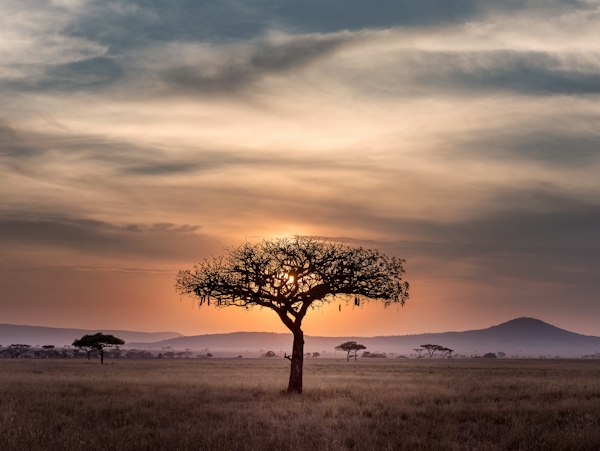
A flat-topped mountain above two oceans. The Kruger National Park’s Big Five on the same continent where they evolved. A coastline of 2,798km. Wine made since 1659 in a valley that looks like a smaller, warmer Provence. South Africa keeps confounding every visitor who thought they already knew what it was.
South Africa (population 62 million — 11 official languages — a constitutional democracy since 1994 — 1,221,037 km² at the southern tip of the African continent — uniquely the world’s only country to voluntarily dismantle its nuclear weapons programme and the only country with three co-equal capitals: Pretoria (administrative), Cape Town (legislative), and Bloemfontein (judicial)) is the most diverse and most self-drive-accessible country in sub-Saharan Africa. It is also, for Australians, one of the world’s best-value premium destinations: the Rand exchange rate (ZAR 13–14 per AUD$1) means five-star Cape Town hotels at 40–50% below comparable Australian rates, and estate-bottled Pinotage at AUD$8 per bottle at the cellar door.
The five defining experiences: Cape Town (Table Mountain, Robben Island, the Bo-Kaap, the Cape Peninsula’s Chapman’s Peak Drive, and Boulders Beach’s African penguin colony). Kruger National Park (19,485 km² of Big Five self-drive — the only major African park where a standard sedan and a personal game drive are both safe and productive). The Garden Route (300km from Mossel Bay to Storms River — the Knysna Heads, the Cango Caves, and the Tsitsikamma suspension bridge). The Cape Winelands (Stellenbosch, Franschhoek, and Paarl — making wine since 1659 — Pinotage bred at Stellenbosch University in 1925 from Pinot Noir and Cinsaut). The Overberg Coast (Hermanus — the world’s finest land-based whale watching, southern right whales June–November — and Gansbaai, 30km east, where the great white shark cage dive offers the closest encounter with Carcharodon carcharias accessible from any shore-based operation in the world).
South Africa’s regions are distinct enough to each justify a separate visit. Here is how to navigate the country’s extraordinary variety.
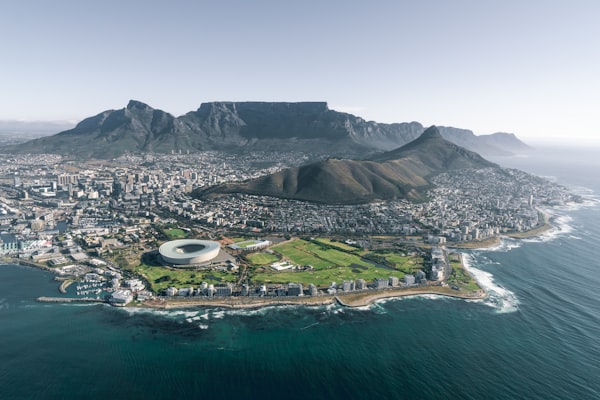
Cape Town (population 4.6 million metro — founded by the VOC in 1652 as a refreshment station for ships rounding the Cape — consistently ranked among the world’s most beautiful cities) sits at the junction of the Indian and Atlantic Oceans beneath the 1,085m flat-topped mountain that has oriented mariners since Bartolomeu Dias rounded the Cape in 1488. Table Mountain (one of the New Seven Wonders of Nature — the cable car’s revolving cabin ascends to the 3km² summit plateau — the fynbos above: 8,700 plant species in the Cape Floristic Region, 70% endemic, more diversity per km² than any other biome on Earth). Robben Island (the prison where Nelson Mandela served 18 of his 27 years — the cell block guided by a former political prisoner whose own biography provides context no museum label can — the most important historical site in South Africa). The Cape Peninsula (Chapman’s Peak Drive — the 9km cliff road carved into the granite face above the Atlantic — Boulders Beach’s 3,000 African penguins (Spheniscus demersus — year-round resident, no seasonal departure, 2-metre approach distance) — Cape Point). The Bo-Kaap (the painted houses of the Cape Malay community — the descendants of enslaved people brought from South Asia, Madagascar, and East Africa by the VOC — the houses painted in a tradition originating with emancipation on 1 December 1834).
The Kruger National Park (19,485 km² — established 1898 as the Sabi Game Reserve by President Paul Kruger — one of Africa’s largest reserves and the prototype for African national park management) is the only major African national park where self-drive in a standard sedan is both safe and productive: sealed game roads, accessible SANParks rest camps (Skukuza, Satara, Berg-en-Dal), and a sighting-board system at each camp where guests pin GPS locations and species of recent encounters. The Sabi Sand Private Game Reserve (65,000 hectares bordering Kruger’s western fence — unfenced from the national park, giving free wildlife movement — the highest leopard-sighting density in Africa, the cats habituated to vehicles over 50+ years — night game drives and walking safaris available, both impossible in the national park). The Big Five concept (originally coined by big game hunters for the five most dangerous to hunt on foot — lion, leopard, elephant, buffalo, rhinoceros — all present in the central Kruger around Skukuza and Satara — the H12/S100 triangle near Satara is the most productive Big Five zone — the camp manager provides current sighting reports at check-in).
The Garden Route (the N2 from Mossel Bay to Storms River — 300km of indigenous forest, Outeniqua mountains, lagoons, and the remarkable biodiversity of the corridor between range and sea) is the finest self-drive route in South Africa. Knysna (the Knysna Heads — the twin sandstone cliffs guarding the lagoon entrance — the Featherbed Nature Reserve on the western Head, ferry-only access, 3-hour guided walk with 80m drop to the ocean below — the Knysna Seahorse (Hippocampus capensis — the world’s most endangered seahorse species, endemic to this lagoon only) — the Knysna Oyster Company, the freshest oysters in South Africa shucked directly from the lagoon cages). Tsitsikamma National Park (the “place of sparkling water” in Khoikhoi — the Storms River Mouth suspension bridge, 77m above the gorge carved by the Storms River through Tsitsikamma quartzite — the most photographed feature on the Garden Route — the Otter Trail (5 days, 42.5km cliff-top coastal walk — book 6–12 months ahead at SANParks)). Cango Caves inland from Oudtshoorn (the most extensive show cave in Africa — 6km mapped — the Adventure Tour’s Devil’s Chimney: a genuine 25cm gap — do not attempt if claustrophobic — the Heritage Tour is the non-claustrophobic alternative).
The Cape Winelands (Stellenbosch — the second-oldest European-founded settlement in South Africa (1679), the oak-lined Dorp Street, the Cape Dutch architecture, and the Stellenbosch University where Pinotage was bred in 1925 by Professor Abraham Perold crossing Pinot Noir and Cinsaut (then called Hermitage — hence the name)) — Franschhoek (the “French Corner” — settled by 200 Huguenot refugees in 1688 — the Huguenot families (de Villiers, du Plessis, Joubert, du Toit) whose names appear on the valley’s most celebrated wine labels — the most culinarily concentrated small town in South Africa — the 1.5km Huguenot Road a parade of serious restaurants — the Wine Tram (hop-on/off connecting the valley’s estates — the most civilised full day available in the Winelands)) — Paarl (the Berg River valley — the Paarl Rock (the second-largest granite boulder in the world after Uluru — 650m long — the gleaming quartzite surface that gave the town its name (“paarl” = “pearl” in Dutch — the rock glistens after rain)) — Vergelegen estate in Somerset West (established 1700 — the camphor trees planted by Willem Adriaan van der Stel are 325 years old and heritage-listed — the Cape Dutch manor house (1709) is one of the finest examples of Cape Dutch architecture in existence).
The Overberg coast (from Hermanus to Cape Agulhas) is the world’s finest land-based whale watching destination and contains the most accessible great white shark encounter in the world. Hermanus (122km from Cape Town — the world’s only dedicated land-based whale watching town, employing a paid whale crier who walks the streets blowing a kelp horn since 1992 to announce sightings) receives the Southern Right Whale (Eubalaena australis) June–November as the population migrates from sub-Antarctic feeding grounds to calve in Walker Bay. The cliff path above Walker Bay provides viewing from 5–20m above the water — cows with calves often within 30m of the cliff edge — the calves learning to breach (young whales practising the motion — the inelegant attempts are sometimes more engaging than the adults’ finished performance). Gansbaai (30km east of Hermanus — the great white shark cage dive in Shark Alley, the channel between Dyer Island (50,000 Cape fur seals) and Geyser Rock — the sharks concentrated year-round by the seal prey — cages lowered from the vessel’s side, sharks free-swimming at 3–5m — the largest verified great whites at Gansbaai measured 5.9–6.1m — Marine Dynamics is the operator that leads in scientific integrity). Cape Agulhas (the true southern tip of Africa — the 1849 lighthouse at the exact meridian where the Indian and Atlantic Oceans officially meet).
The uKhahlamba-Drakensberg (“Barrier of Spears” in Zulu — UNESCO World Heritage 2000 — the 1,000km escarpment forming the eastern edge of the South African plateau) is the most dramatically vertical mountain landscape in South Africa. The Amphitheatre in the Northern Drakensberg (the 5km basalt cliff face — 1,200m vertical drop — the Tugela Falls descending in five cascades — 948m total, the second-tallest waterfall in the world after Angel Falls Venezuela — the 11km return hike from Mahai campsite involves a chain ladder section near the summit). The San rock art (35,000+ individual images in over 600 shelters across the Drakensberg — the world’s most concentrated collection — produced over 8,000 years — the Giant’s Castle guided walks provide the most interpretively rich visits). The KwaZulu-Natal Battlefields (Isandlwana — 22 January 1879 — 1,300 British and colonial troops killed, the most catastrophic British colonial defeat in Africa — Rorke’s Drift — 139 British soldiers defending a mission station against 3,000–4,000 Zulu warriors the same evening — 11 Victoria Crosses awarded, the most for any single action in British military history).
Every SANParks rest camp in the Kruger (Skukuza, Satara, Lower Sabie, Berg-en-Dal, Olifants, Letaba) has a sighting board in the reception area — a physical map of the surrounding roads where guests returning from game drives pin a marker at the GPS location and species of each sighting from the past 24 hours. This board is updated in real time by the guests themselves and is the most accurate wildlife intelligence in the park. The first thing to do on arrival at any Kruger camp is to study the sighting board, identify the 2–3 highest-value sightings closest to the camp, and plan the next morning’s drive around those coordinates. The guide-book equivalent of this information costs USD$200+ per hour in the private reserves — at SANParks camps it is pinned to a corkboard in the reception and is completely free.
South Africa’s wine story is 365 years old. Its best chapters are being written now.
Named for the 17th-century cannon fired to announce supply ships rounding Cape Point, Kanonkop is the estate that defines what South African Pinotage can be at its finest. The Paul Sauer (Cabernet Sauvignon–dominant blend — the most awarded Cape red blend in South Africa’s wine history). Winemaker Abrie Beeslaar has maintained the estate’s consistency since succeeding Jan “Boland” Coetzee in 2001. Tasting by appointment on the R44, 20 minutes from Stellenbosch. The estate building is unpretentiously serious — the wines match.
Marc Kent’s Syrah — the Boekenhoutskloof expression from Franschhoek’s granite and clay soils — consistently in the Wine Spectator Top 100 in submitted vintages and the wine most responsible for South African Syrah’s international credibility. The tasting room in the 1776 manor house is the most beautiful cellar interior in Franschhoek. Visitor numbers strictly limited — book in advance. The Wolftrap and Porcupine Ridge ranges are the accessible entry points to the house style.
Eben Sadie’s Columella (Swartland red — Syrah and Mourvèdre from 30–80-year old dryland bush vines) and Palladius (Swartland white — old-vine Chenin Blanc blend) are routinely rated among the world’s top 50 wines. Sadie co-founded the Swartland Revolution in 2009, catalysing a generation of minimal-intervention winemakers and permanently repositioning South African wine internationally. Wines available by mail order and at top Cape Town wine bars — not from the winery directly.
Established 1700 by Willem Adriaan van der Stel (seized so extravagantly from neighbouring farms that the Lords XVII recalled him in 1706). The camphor trees he planted are now 325 years old and heritage-listed. The Cape Dutch manor house (1709) is one of the finest in existence. The Vergelegen V (Cabernet Sauvignon–dominant blend from 400–500m Helderberg hillside vineyards) is among the Western Cape’s most consistently excellent reds. Allow 3 hours — the Lady Phillips restaurant lunch is the best in Somerset West.
South Africa’s post-1994 story — the transition from apartheid to constitutional democracy, the Truth and Reconciliation Commission, Mandela’s presidency — is the most extraordinary political transformation of the 20th century’s last decade. That story is present in the country’s landscape in ways no reading prepares you for. Robben Island is not a ruin; it is the island where Mandela was imprisoned for 18 years and where his cell is maintained exactly as it was. The District Six Museum is not a memorial; it is the active documentation of a neighbourhood the apartheid government erased.
But South Africa also cooks the world’s best braai (the wood-fire barbecue that is a cultural ceremony as much as a cooking method — the correct word is “braai”; “barbecue” describes the equipment, not the event, and Australians are forgiven one misuse before being gently corrected by any South African host). It makes wine that scores 94 points from Wine Spectator and sells for ZAR 150 (AUD$11) at the estate shop. Its national parks were designed to be driven through by anyone with a hire car and a 5:30am alarm. It built Cape Town — arguably the most beautiful city on Earth to arrive at by aircraft on a clear morning.
From a Cape Town city week to the full South Africa grand circuit — all bookable through Cooee Tours.
Seven nights in Cape Town — the city that rewards early mornings above all else. Accommodation options centred on the V&A Waterfront (most convenient for the Robben Island ferry and Two Oceans Aquarium), De Waterkant (the Cape Malay quarter — the most interesting neighbourhood base), or the Atlantic Seaboard (Sea Point — the best morning run in Cape Town along the Promenade). The programme: Table Mountain (cableway, pre-booked — allow 3 hours on the summit, including the Agama Trail past the dassie (rock hyrax) colonies), Robben Island (the half-day ferry tour — book 2+ weeks ahead — the cell block guide is a former political prisoner whose personal history provides what no museum label can), Cape Peninsula drive (Chapman’s Peak → Cape Point → Boulders Beach penguins → Simon’s Town), Bo-Kaap morning walk, District Six Museum, the Woodstock Biscuit Mill Saturday market, and a Winelands day trip to Stellenbosch and Franschhoek (the Wine Tram or hire car). Cape Town’s restaurant scene (centred on Bree Street, the V&A, and Woodstock — La Colombe, Shortmarket Club, The Pot Luck Club, and Nobu Cape Town booking 4–6 weeks ahead in peak season — Cooee Tours pre-reserves the guest’s shortlist on their behalf).
The Kruger self-drive safari — the experience that most distinguishes South Africa from every other African wildlife destination: driving your own hire car through the world’s most famous national park at your own pace, stopping as long as you choose at a sighting, departing at 5:30am when the camp gates open and predator activity peaks. The pre-set 5-night circuit covers the two most productive zones: Skukuza (southern Kruger — the most consistent predator area) and Satara (central — the H1-4 waterhole and lion prides). The sighting board at each camp’s reception — the guest-updated map of the past 24 hours’ encounters — is the best free wildlife intelligence in Africa. Bush walk with an armed ranger (3 hours, 5:30am departure — the elephant dung, the broken acacia, the tracks that the vehicle drive’s pace obscures). Fly Johannesburg–Skukuza direct (45 minutes by charter — avoids the 4.5-hour N4 highway). Full pre-departure brief includes current camp sighting intelligence, road conditions, and the specific H-road and S-road circuit for each camp.
The Sabi Sand Private Game Reserve (65,000 hectares bordering the Kruger’s western fence — unfenced, giving the wildlife free movement — the highest leopard-sighting density in Africa, the cats habituated to vehicles over 50+ years) is the premium version of the South African safari. Guided drives in open-sided Land Rovers (maximum 6 guests — the tracker on the “tracker seat” mounted at the bonnet’s front reading wind, broken vegetation, fresh tracks — while the guide manages the vehicle and guest briefing simultaneously). Night game drives (the leopard’s hunting technique, the genets, the civets, the aardvark — the nocturnal animals invisible in daylight). Bush walks (armed ranger and tracker on foot — the ecosystem at walking pace). Camp options: Londolozi, Singita, &Beyond MalaMala, Royal Malewane, Chitwa Chitwa — ranging from exceptional to the globally finest lodge experience. All meals, all game drives, all park fees, and laundry included. Three nights is the minimum; four or five provides the full rhythm of the camp and the maximum sighting variety.
The Garden Route self-drive — Cape Town to Port Elizabeth (Gqeberha) — one-way hire car, 8 nights pre-booked along the route, the N2 as the spine. Day 1: Cape Town to Hermanus (2hrs — cliff-path whale watching June–November, or Gansbaai shark cage dive). Day 2: Hermanus to Mossel Bay via the Tradouw Pass (the most dramatic mountain pass in the Western Cape — the 22-arch railway viaduct visible from the road). Day 3: Mossel Bay to Wilderness (the Wilderness Lakes System — 5 connected lakes, the best kayaking in the Western Cape — the Outeniqua Pass into George). Day 4: Wilderness to Knysna (Featherbed ferry + walk, oysters from the lagoon). Day 5: Knysna inland to Cango Caves via Oudtshoorn (the Adventure Tour — the 25cm gap — the Heritage Tour for those who decline). Day 6: Knysna to Plettenberg Bay (Robberg Peninsula 4km circuit — 10,000 Cape fur seals, dolphins in the bay). Day 7: Plett to Tsitsikamma (Storms River suspension bridge, the river-mouth pool swim at 18–21°C). Day 8: Tsitsikamma to Port Elizabeth via Addo Elephant National Park (600 elephants, the most relaxed elephant encounter in South Africa — no predator pressure, no need to stay in the vehicle on the viewing walkways).
The Cape Winelands immersion — 4 nights based in the Winelands themselves (not day-tripping from Cape Town) allowing the 9:30am estate tasting before the tour coaches arrive, which is categorically different from the same estate at 11am. Day 1: Stellenbosch arrival, Dorp Street walk, the Rupert Museum (the most important private South African art collection accessible to visitors — free entry), Kanonkop appointment tasting (the Pinotage and the Paul Sauer — the benchmark Cape red). Day 2: Franschhoek full day (Wine Tram morning circuit — 4–5 estates — Boekenhoutskloof manor tasting — lunch at La Petite Colombe (book 3+ weeks ahead) or the Tasting Room at Le Quartier Français (Africa’s most consistent fine dining restaurant)). Day 3: Paarl and Swartland (Paarl Rock drive, the KWV Cathedral Cellar — the barrel hall’s domed ceiling, the Malmesbury Swartland estates). Day 4: Vergelegen (the 1700 estate — the camphor trees, the Lady Phillips lunch, the Vergelegen V tasting). Return Cape Town.
The Overberg 2-day circuit — the two most visceral wildlife encounters within a 2-hour drive of Cape Town. Day 1: Hermanus cliff path (June–November). The southern right whales in Walker Bay at 9am — best light, calmest sea, fewest tourists. The cows with calves often within 30m of the cliff edge — the calves learning to breach, their inelegant attempts sometimes more compelling than the adults’. Optional whale kayak (Walker Bay Adventures — the 50m permitted approach from water level calibrates the cliff-path distance correctly — at 50m from a 40-tonne southern right whale you understand why the distance is permitted rather than closer). Overnight Hermanus. Day 2: Gansbaai shark cage dive (Marine Dynamics — 7am departure — 45-minute cruise to Shark Alley — the guide’s briefing on the white shark’s Ampullae of Lorenzini (the pore network on the snout detecting the electrical fields of muscle contractions — the most sensitive biological electrical detector on Earth) — cage lowered from the vessel side — 20–40 minutes in the cage — typically 3–6 shark sightings). Return Cape Town via the R43 coastal road.
The Cape Peninsula full day — the 75km drive from Cape Town to Cape Point and back via Boulders Beach — the most complete single day in the Western Cape. Depart 8:30am: Hout Bay harbour market and the Mariner’s Wharf (the freshest fish and chips in the Cape, served above the fishing boats). Cape of Good Hope Nature Reserve (7,750ha at the peninsula’s southern end — the Cape Baboon (Papio ursinus ursinus) briefing: bold, strong, effective — store all food in the boot — the Cape Point lighthouse via funicular at 87m above the sea — the actual Cape of Good Hope headland, where the cold Benguela Current from the Antarctic and the warm Agulhas Current from the Indian Ocean produce the turbulence that made this the most feared rounding in Age of Sail navigation). Chapman’s Peak Drive (9km cliff road — 12 tunnels carved into the cliff face — the Atlantic below, the Sentinel above). Boulders Beach penguin colony (arrive 2:30pm when the day-trippers have largely left — the penguins entirely indifferent to visitors at 2m, the nesting pairs visible in sand burrows and under the boulders).
The Drakensberg and KwaZulu-Natal Battlefields circuit — 5 nights combining the mountain UNESCO landscape with the Anglo-Zulu War’s most resonant sites. Durban (1 night — the bunny chow at the Patel Vegetarian Refreshment Room (272 Grey Street, since 1940 — the quarter-loaf of bread hollowed and filled with curry), the Victoria Street Indian spice market, the Golden Mile beachfront). Battlefields (2 nights from Dundee — Isandlwana on 22 January 1879 (the guide walks the chronology of 1,300 deaths — the white cairns marking burial positions visible from the approach road — the first British defeat by an indigenous African force in the colonial period), Rorke’s Drift (the museum at the exact location of the defended cattle kraal — 11 VCs awarded)). Northern Drakensberg (2 nights at Royal Natal National Park — the Amphitheatre hike (11km return — 6–8 hours — the chain ladder near the summit, the Tugela Falls (948m) below from the top — the landscape that justifies the UNESCO inscription), the Giant’s Castle San rock art guided afternoon walk (35,000+ images, 8,000 years of accumulation, the eland hunting panels in ochre and white)).
The South Africa Grand Circuit — Cape Town, Winelands, Overberg Coast, Garden Route, and the Kruger in a fortnight — designed as a self-drive circuit with two fly-in segments eliminating the least scenic driving. Cape Town (3 nights — Table Mountain, Robben Island, Cape Peninsula, Bo-Kaap, restaurant reservations pre-set). Winelands (2 nights — Stellenbosch, Franschhoek Wine Tram, Kanonkop, Boekenhoutskloof). Hermanus + Gansbaai (1 night — whale season June–November; shark cage dive year-round). Garden Route self-drive (5 nights — Wilderness, Knysna, Tsitsikamma, Plettenberg Bay — the Cango Caves, Storms River bridge, Robberg Peninsula). Fly Port Elizabeth–Skukuza (Air Link, 1hr). Kruger or Sabi Sand (2 nights — private reserve for night drives and tracking, or SANParks self-drive camps for independence). Fly Skukuza–Johannesburg–Brisbane. All hire car bookings, accommodation, and internal flights included. The Gansbaai shark dive is weather-dependent — a same-day confirmation system with a backup activity is built into the itinerary.
The Western Cape has a Mediterranean climate — dry and sunny in summer, wet in winter. The Kruger’s best game viewing is exactly the opposite: dry season winter.
The Western Cape summer (November–April) delivers Cape Town at its finest: 16–18 hours of daylight at the December solstice, the Atlantic Seaboard swimmable at 18–21°C, and the Winelands harvest in March–April (the crush, the new wine, the estate activity at its most animated). The South-Easter (the Cape Doctor — the prevailing southeasterly that blows the “tablecloth” cloud over Table Mountain) cleans the air and reduces humidity. Peak Christmas–New Year and Easter weeks are the most expensive and crowded — book 6 months ahead. The whale season (June–November) falls in winter — so the optimal South Africa circuit uses the winter for the Overberg whales and Kruger game viewing, positioning Cape Town either as the arrival city in shoulder autumn (April–May, excellent weather, lower prices) or as the departure city in shoulder spring (September–October).
The Kruger’s dry season (May–October) is peak safari season: the vegetation is low, water concentrates at permanent waterholes (making wildlife predictable), and predator sighting rates are at their highest (September–October, when the bush is at its thinnest, produce the clearest visibility). July and August are the coldest months (0–8°C overnight) — the dawn drive requires a down jacket — but also produce the highest visibility and the lowest tick and malaria risk. The “Green Season” Kruger (November–April): lush, photogenic, lower rates (20–30% less), but dense vegetation reduces visibility significantly. The Sabi Sand in February in the rain is beautiful; the leopard sighting rate drops by roughly half compared to September. Do not plan the Kruger around December–January unless you specifically want the wet-season aesthetic rather than the game-viewing peak.
Three circuits — from 7 nights in the Cape to the full 12-day Cape and Kruger combination.