🪃 The Cultural Significance of Aboriginal Art
In Aboriginal culture, art is not created for galleries or collectors. It functions as a repository of knowledge, a legal document establishing connection to Country, a teaching tool for younger generations, and a spiritual practice connecting living people to ancestors and Dreamtime. What appears to outsiders as beautiful abstract pattern is often a sophisticated mapping system, a genealogy, detailed seasonal ecological information, or a ceremonial communication that visitors are only seeing a partial, public layer of.
The Australian Institute of Aboriginal and Torres Strait Islander Studies (AIATSIS) notes that Aboriginal art serves as both cultural archive and living practice — continuously evolving while maintaining deep connections to ancient traditions. Creating art is often itself a ceremonial act. The process of painting, singing associated songs, and working with traditional materials connects artists to ancestors and Country. This is why understanding context — and obtaining permission before photographing or reproducing Aboriginal art — matters.
Aboriginal artworks typically contain multiple simultaneous layers — some public, accessible to any viewer; some available only to initiated community members; some for specific gender groups or ceremonial contexts. Never assume you fully understand an artwork's meaning without consulting the artist or an authorized interpreter. Respectful observation means acknowledging what you don't and can't know.
🪨 Ancient Aboriginal Art: Rock Art & Ochre
Australia contains some of the world's most extensive rock art galleries, with sites dating back over 65,000 years — predating European cave art. Research published in Nature Human Behaviour places some Australian rock art among humanity's oldest artistic expressions. These sites are not merely historical curiosities; they remain active cultural sites for Aboriginal communities with ongoing spiritual and legal significance.
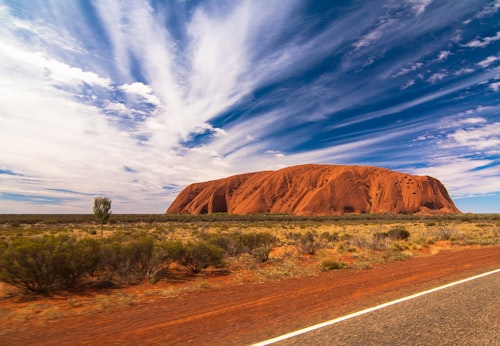
Kakadu National Park, NT
Over 5,000 rock art sites including X-ray style paintings depicting animal anatomy in extraordinary detail. Cooee Tours' Kakadu tours visit major galleries with Aboriginal custodian interpretation — hearing the stories from Traditional Owners is irreplaceable.
Kimberley Region, WA
The enigmatic Wandjina spirit figures and Gwion Gwion (Bradshaw) paintings — some potentially over 17,000 years old — are among the world's most remarkable ancient image-making. Wandjina figures with their distinctive haloed faces are owned by specific Ngarinyin, Wunambal, and Worora language groups.
Cape York & Quinkan Sites, QLD
The Quinkan rock art galleries feature elaborate Quinkan spirit figures in a distinctive style. Grampians (Vic) has distinctive hand stencils from southeastern traditions. Flinders Ranges (SA) features ancient engravings in dramatic outback landscapes.
Ochre — The Ancient Medium
Aboriginal artists have used ochre — naturally occurring iron oxide pigments — for tens of thousands of years. Ochre comes in reds, yellows, whites, and blacks depending on mineral composition, and carries deep spiritual significance. Many ochre deposits are considered sacred, with collection requiring appropriate permissions and ceremonies. When you see these earth tones in contemporary dot painting, you are looking at a colour palette with 65,000 years of continuous cultural use.
🗺️ Regional Styles of Aboriginal Art
Aboriginal art is extraordinarily diverse — there are hundreds of distinct regional styles reflecting different language groups, Country, and cultural traditions. When someone says "Aboriginal art," they may be thinking of dot painting — but this is one style from one region, emerging only in the 1970s. The full scope is far wider.
Central Desert Dot Painting
The iconic dot painting style emerged at Papunya in the early 1970s when Aboriginal artists began painting traditional sand ceremony designs on canvas using acrylics. Intricate dot patterns create aerial-view maps of Country — concentric circles for waterholes, U-shapes for people, connecting lines for travel routes. Artists include Emily Kame Kngwarreye and Clifford Possum Tjapaltjarri.
Arnhem Land Bark Painting
Bark paintings using natural ochres on stringybark, featuring intricate rarrk (crosshatching) clan designs that create shimmering surface effects. X-ray style paintings depict animals with internal organs visible — detailed anatomical knowledge from hunting. These designs are owned by specific clans and may only be painted by authorized individuals.
Urban & Contemporary Aboriginal Art
Contemporary Aboriginal artists work across acrylics, photography, sculpture, digital media, and performance art — blending traditional symbolism with modern techniques to address current issues. Artists like Brook Andrew, Vernon Ah Kee, and Richard Bell exhibit in major international galleries. Urban Aboriginal art is not less "authentic" for being contemporary.
Kimberley, Tiwi Islands & Others
Kimberley art features Wandjina spirit figures and Gwion Gwion traditions. Tiwi Islands (NT) have a distinct tradition of pukumani burial poles and fabric printing. Torres Strait Islander art reflects Melanesian influences with printmaking, ceremonial masks, and maritime themes that deserve separate recognition.
⭕ Aboriginal Art Symbols — A Partial Guide
Aboriginal art uses a sophisticated symbolic language where elements carry specific meaning — but interpretations vary significantly between regions and language groups, and many symbols carry multiple meanings depending on context. This guide covers the most widely understood public-layer meanings of common Central Desert symbols. It is not comprehensive, and should not be treated as a complete key.
Concentric Circles
Most commonly represent waterholes, campsites, or ceremonial sites. The most vital elements in desert landscapes — waterholes feature in Dreamtime stories and survival knowledge. May also represent hills, fire, or other landscape features depending on context.
U-Shapes
Typically represent people sitting, with the opening indicating orientation. Multiple U-shapes show groups gathered for ceremony, a family camp, or hunting parties. The items depicted between or near U-shapes (spears, coolamons, digging sticks) identify gender and activity.
Straight Lines
Often depict travelling routes, spears, lightning, or connections between places. The context within the artwork — what they connect, their color, their orientation — determines specific meaning in each work.
Dotting Patterns
Can represent clouds, rain, fire, smoke, sand, or the landscape itself. Dot patterns emerged partly as a way to obscure restricted sacred designs for public display — the dots both reveal and conceal layers of meaning simultaneously.
Animal Tracks
Specific patterns represent different animals — emu, kangaroo, lizard, snake, goanna — important for hunting stories and totemic connections. Reading tracks in sand was essential survival knowledge; encoding them in art preserved and transmitted that knowledge.
Arcs & Semi-Circles
May represent windbreaks, boomerangs, rainbow serpents, or digging sticks depending on style and context. Rainbow Serpent imagery — the great creator being of waterways — appears across many Aboriginal cultures in varied forms.
Never assume you fully understand an Aboriginal artwork's meaning. Many paintings contain public and restricted layers — some content is accessible to any viewer, some is for initiated community members only, some is gender-specific or ceremonially restricted. This layered structure is intentional and meaningful. Respectful engagement means acknowledging depth you cannot fully access, not claiming expertise you haven't earned through relationship.
⚠️ The Fake Art Problem — What You Need to Know
The Aboriginal art market's international success has attracted serious exploitation. The Arts Law Centre of Australia estimates that approximately 80% of "Indigenous-style" art sold in Australian tourist shops is fake — made overseas (often Indonesia or China) by non-Indigenous manufacturers and sold to unknowing buyers as authentic Aboriginal art.
This is not a victimless industry problem. Fake Aboriginal art provides zero economic benefit to Aboriginal artists or communities. It devalues authentic works. It violates copyright law by copying real Aboriginal artists' designs. And — most significantly — many Aboriginal designs carry restricted sacred knowledge that is not meant to be shared or reproduced. Fake art created without cultural authorization may disseminate restricted ceremonial knowledge that belongs exclusively to specific communities.
Tourist shops selling dozens of identical pieces at very low prices. "Aboriginal-style" or "Aboriginal-inspired" labelling rather than specific artist attribution. No artist name or generic attributions ("Central Desert artist"). Made in Indonesia, China, or similar origin labelling. Extremely low prices — a large authentic Aboriginal canvas for $50 is not possible. Aggressive sales tactics. Inability to answer basic questions about the artist or art centre. Mass-produced printed items (cushions, tea towels) with Aboriginal patterns — unless explicitly licensed by a named artist.
✅ How to Buy Aboriginal Art Ethically
When you purchase authentic Aboriginal art through ethical channels, you are directly supporting Indigenous artists, families, and communities — contributing to cultural preservation, economic self-determination, and reconciliation in the most tangible way possible.
Community Art Centres — The Gold Standard
The most reliable way to buy authentic Aboriginal art ethically is through Aboriginal community-run Art Centres. Art Centres are Aboriginal-owned and managed businesses specifically designed to produce and distribute ethically created Indigenous art while providing fair income, training, and cultural support for artists. The certificate of authenticity from an Art Centre — not a gallery — is the strongest guarantee you can receive. It should include: the artist's full name, language group, community and Country, the story behind the artwork, and a catalogue number linking the work back to the Art Centre's records.
Peak bodies supporting Art Centres include: Desart (34 Central Australian art centres, representing 8,000 artists), ANKA (Arnhem Land, Northern and Kimberley Artists), IACA (Far North Queensland), and Ku Arts (South Australia).
The Indigenous Art Code
The Indigenous Art Code is a voluntary industry code of conduct established in 2009 with Federal Government support to promote ethical trading. Signatories commit to fair and honest dealings, respect for cultural intellectual property rights, and transparency in the sale of Indigenous artwork. Galleries displaying the Indigenous Art Code logo have committed to these standards — verify certified members at indigenousartcode.org before purchasing. As Indigenous Art Code chair Stephanie Parkin has noted: ethical purchasing means "everyone wins — you get better art by artists culturally connected to the story they have painted, and they get a fair deal free from exploitation."
The Darwin Aboriginal Art Fair (DAAF) is Australia's largest First Nations art fair — and one of the best opportunities to purchase authentic Aboriginal and Torres Strait Islander artwork directly from Art Centres, with full cultural context and guaranteed ethical sourcing. The 2026 event (6–9 August at Darwin Convention Centre) marks the fair's 20th anniversary, with Art Centres from across the Northern Territory, Kimberley, Queensland, and South Australia represented. Artists are often present to discuss their work. See daaf.com.au for ticketing and participating Art Centres.
Where to Buy: Trusted Channels
In addition to community Art Centres and DAAF, these are reliable channels for ethical purchasing. ART ARK (artark.com.au) operates entirely with community-run Art Centres and has over 1,640 verified five-star reviews. Japingka Aboriginal Art (Perth) is a foundation member of both the Aboriginal Art Association and the Indigenous Art Code with over 30 years of experience. Artlandish Aboriginal Art Gallery (Kimberley WA, online) has 25 years of operation with free worldwide shipping and certificates from named Art Centres. AIATSIS Shop, National Gallery of Australia, and state museum shops consistently sell authentic art with proper cultural protocols.
Questions to Ask Before Purchasing
- Who is the artist, and what community and Country are they from?
- What percentage of the sale price does the artist receive directly?
- Does the certificate of authenticity come from the Art Centre itself — not just the gallery?
- Are you a member of the Indigenous Art Code?
- Can you explain the story behind this specific artwork?
- What is the provenance — where was this work made and how did it come to you?
- Has the artist authorized the sale of this work?
Authentic small-to-medium Aboriginal paintings by emerging artists typically start around $200–$500. Works by established artists range from $1,000 to tens of thousands. Museum-quality pieces by renowned artists can reach hundreds of thousands at auction — Emily Kame Kngwarreye's "Earth's Creation" sold for over $2 million AUD. If something is too cheap to seem real (a "large Aboriginal painting" for $50), it is not authentic Aboriginal art. The majority of the sale price — ideally 50–60% or more — should go directly to the artist.
💬 Common Misconceptions Addressed
"All Aboriginal Art Looks the Same"
Aboriginal art encompasses hundreds of distinct regional styles reflecting diverse language groups, Country, and cultural traditions across a continent. Dot painting is one style from one region, emerging in the 1970s. Aboriginal art includes bark painting, rock art, sculpture, weaving, fibre art, lino printmaking, photography, contemporary mixed media, and countless other forms. This diversity is one of the most underappreciated aspects of the tradition.
"Anyone Can Paint Aboriginal-Style Art"
Creating or selling "Aboriginal-style" art without being Aboriginal constitutes cultural appropriation and is deeply disrespectful — full stop. Aboriginal art is not a visual aesthetic to be imitated. It is a cultural and ceremonial practice encoding specific knowledge, Dreamtime stories, and connections to Country that belong to specific Aboriginal communities, often through specific family lineages. Non-Indigenous people can appreciate, collect, and ethically purchase Aboriginal art — but should not create or sell works imitating Aboriginal artistic traditions.
"Aboriginal Art is Only Traditional, Not Contemporary"
Contemporary Aboriginal artists work across every medium and style, addressing modern issues — the effects of colonization, Stolen Generations, land rights, urban Indigenous identity, climate change — while maintaining deep cultural connections. Contemporary Aboriginal art is not less authentic for being new. The tradition is living, not fixed.
"Aboriginal Artists Are Only in Remote Communities"
Aboriginal artists live and create across Australia — in cities, regional centres, and remote communities. Urban Aboriginal artists create powerful work exploring contemporary Indigenous experiences while maintaining cultural connections that are no less real for being urban. Assuming all Aboriginal artists are remote desert painters reflects a stereotype, not reality.
Experience Aboriginal Art in Cultural Context
The most meaningful way to understand Aboriginal art is to experience it with Aboriginal artists and knowledge holders — visiting rock art sites with Traditional Owners, participating in art workshops, and meeting artists in their communities. Cooee Tours can connect you with these experiences from Brisbane.
Explore Indigenous Experiences →