🇨🇦 Second-Largest Country · 10 Provinces · 3 Territories

The World’s
Second-Largest Country.
Almost Empty.

Turquoise glacier lakes in Banff that don’t look real. Polar bears walking the Churchill tundra in October. The aurora borealis above the Yukon’s boreal forest at midnight. A walled city in North America that looks like it was stolen from Normandy. And 9.9 million square kilometres with fewer people than Australia.

9.98M km²
World’s 2nd Largest Country
38 million
Population · Less than Australia’s density
−40°C
Winter Min · Yukon & Northern Prairies
Oct–Nov
Churchill Polar Bear Season
20 hrs
Direct Flight from Sydney
🇨🇦 Canada Guide
The Second-Largest Country on Earth

Canada — More Wilderness
Per Person Than Anywhere
Else on Earth

Canada (population 38 million — the 39th most populous country in the world, spread across 9.98 million km² — the second-largest country on Earth by total area, with a population density of 3.9 people per km² compared to Australia’s 3.5 — the two countries are statistically similar in population density but Canada’s density is further skewed by the fact that 90% of Canadians live within 160km of the US border, leaving the northern 70% of the country essentially empty) is the destination that consistently most surprises visitors who arrive expecting it to be “like the United States but politer.” Canada’s dominant character is defined not by its cities — though Montreal, Quebec City, and Vancouver are world-class urban destinations — but by the scale and variety of its wilderness: the Canadian Rockies, the boreal forest, the Arctic tundra, the Maritime coast, and the Great Lakes collectively constitute the most diverse and most accessible wilderness in the temperate and subarctic world.

The four defining Canadian experiences that have no equivalent elsewhere: Banff National Park (established 1885 — Canada’s first and most visited national park — the Rocky Mountain landscape of Lake Louise, Moraine Lake, and the Icefields Parkway containing the turquoise glacially-fed lakes whose colour — produced by rock flour — finely ground glacial particles of limestone and dolomite in suspension — is the most implausible shade of blue-green in nature, looking at sufficient distance like paint). Churchill, Manitoba (the “Polar Bear Capital of the World” — the point where the Hudson Bay sea ice forms each November, drawing the western Hudson Bay polar bear population — approximately 900 bears — to the coast to wait for the ice — the only place on Earth where polar bears can be reliably observed at close range from land in a natural tundra setting; the beluga whale aggregation in the Churchill River estuary in July brings 3,000–4,000 belugas within swimming distance of the shore). Quebec City (the only remaining walled city north of Mexico — founded in 1608 by Samuel de Champlain — the Vieux-Québec (Old Quebec) UNESCO World Heritage Site containing the Château Frontenac, the Dufferin Terrace, the Rue Saint-Louis, and the Quartier Latin — a European city that exists in the Canadian northeast entirely intact and entirely functioning, where French is the only daily language and the culture is Normandy via 400 years of Canadian winter). The Northern Lights (the aurora borealis — visible from the Yukon, Northwest Territories, and northern Newfoundland between August and April — the Yukon’s Yukon River valley and the Northwest Territories’ Yellowknife — “Aurora Capital of North America” — are the most accessible aurora viewing destinations for Australian visitors).

✅ Canada Practical Essentials
  • Visa / eTA: Australian passport holders do not require a full visa for Canada but must obtain an Electronic Travel Authorisation (eTA) before departure — apply at canada.ca/eta — CAD$7, instant approval in most cases, valid 5 years. The eTA is linked to your passport and checked at check-in — you will be denied boarding without it.
  • Currency: Canadian Dollar (CAD) — approximately CAD$1 = AUD$1.08 (near parity — Canada is not a cheap destination for Australians). ATMs (ABMs in Canadian terminology) widely available. Credit cards accepted everywhere. Tipping: 15–20% at restaurants is standard and non-optional in the social sense — 18% is the safe minimum in all sit-down restaurants.
  • Size: Canada’s scale is the most consistently underestimated planning failure of first-time visitors. Driving from Vancouver to Toronto takes 42 hours. Toronto to Halifax by road is 20 hours. Banff to Churchill requires a flight. Plan regional itineraries — do not attempt to cross-country drive unless you have 3–4 weeks and the Trans-Canada Highway is specifically the purpose.
  • Cold: Canadian winters are genuinely extreme. Yellowknife in January averages −27°C. Churchill in November averages −15°C. Banff in February regularly reaches −25°C overnight. The clothing requirement is specific and cannot be improvised — base layer (merino wool), mid layer (down or fleece), outer layer (windproof shell), balaclava, liner gloves and outer mittens, wool socks. This is not a list; it is a survival requirement.
  • Driving: Canadians drive on the right. International driving licences are accepted. Highway speed limits are 100–110km/h on divided highways, 80km/h on rural roads. Watch for moose — a moose strike at 90km/h is fatal in a small car; moose are most active at dawn and dusk and most common near water. If you see one moose, there are likely two.
Eight Regions

Canada from Coast to Coast to Coast

Canada has three coasts (Atlantic, Pacific, Arctic) and five distinct landscape characters. Here is how to choose your circuit.
Banff National Park Moraine Lake turquoise Canadian Rockies
Banff & the Canadian Rockies
⛰ Alberta · UNESCO · Year-Round

Banff National Park (established 1885 — Canada’s first national park — 6,641 km² of Rocky Mountain wilderness in Alberta, 128km west of Calgary) contains the two most photographed lakes in Canada and among the most photographed in the world: Lake Louise (the Victoria Glacier’s meltwater lake — the colour produced by rock flour (finely ground glacial particles of limestone and dolomite in suspension) changing from deep emerald to brilliant turquoise as the summer melt intensifies — the Fairmont Chateau Lake Louise on the north shore is the most architecturally appropriate hotel in the Canadian Rockies — book 6–12 months ahead for summer) and Moraine Lake (the Valley of the Ten Peaks — formerly on the back of the Canadian $20 bill — a smaller, higher-altitude lake whose colour is an even more implausible turquoise — the lake road is closed to private vehicles from May–October and requires a Parks Canada shuttle reservation or Parks bus — book at reservation.pc.gc.ca months ahead). The Icefields Parkway (Highway 93 — the 230km road between Banff and Jasper, consistently ranked among the world’s most scenic drives — the Columbia Icefield (the largest non-polar icefield in North America — approximately 325 km²), the Athabasca Glacier (accessible on foot from the parkway — walk to the 1992 marker, then the 1982 marker, then the 1948 marker — each represents a year’s worth of glacial recession visible as horizontal distance across the valley floor — the glacier has lost 40% of its volume since 1900 and recedes 5 metres per year on average — the most visceral climate change display available to a visitor anywhere in Canada), and Peyto Lake (the wolf’s-head-shaped lake viewable from a 20-minute walk above the parkway — an even brighter turquoise than Moraine Lake at peak summer melt).

  • Moraine Lake — book Parks Canada shuttle months ahead
  • Icefields Parkway — 230km · Columbia Icefield · Athabasca Glacier
  • Lake Louise — Fairmont Chateau · Victoria Glacier reflection
  • Peyto Lake — wolf’s-head shape, brightest turquoise in the Rockies
  • Banff town — hot springs, gondola, wildlife (elk on the main street at dusk)
Vancouver British Columbia mountains Stanley Park coast
Vancouver & British Columbia
🌎 Pacific Coast · Mountains · Rainforest

Vancouver (population 2.6 million metro — Canada’s third-largest city — on the Pacific coast at the mouth of the Fraser River with the Coast Mountains rising directly behind the city skyline — the only major city in Canada where palm trees grow on the street corners and skiing is possible on the mountains visible from the downtown waterfront) is consistently rated one of the world’s most liveable cities. Stanley Park (a 405-hectare forested peninsula connected to downtown Vancouver by the Causeway — the 8.8km seawall walk around its perimeter, through old-growth Douglas fir and western red cedar trees up to 500 years old, past the Siwash Rock sea stack, the Vancouver Aquarium, and the nine totem poles in Brockton Point Oval — is the finest urban walk in Canada). Whistler (120km north on the Sea to Sky Highway — the most scenic single hour of highway driving in British Columbia — the Howe Sound fjord visible for the first 40km from Vancouver — the Whistler Blackcomb ski resort, the largest in North America by skiable terrain at 8,171 acres, operating ski season December–April and summer activities including mountain biking, ziplining, and the Peak 2 Peak Gondola across the valley between the two mountains at 436 metres above the valley floor). Vancouver Island (the 460km-long island off Vancouver’s Pacific coast — accessible by BC Ferries from Tsawwassen, 1.5 hours — Victoria (the provincial capital — the most British city in Canada outside Ontario, Butchart Gardens, the Empress Hotel for afternoon tea) and the Tofino rainforest on the west coast (old-growth temperate rainforest, whale watching March–October, surfing on Cox Bay)).

  • Stanley Park seawall — 8.8km, old-growth forest, nine totem poles
  • Whistler Blackcomb — largest ski resort North America · Peak 2 Peak Gondola
  • Sea to Sky Highway — Vancouver to Whistler, Howe Sound fjord views
  • Tofino — old-growth rainforest, whale watching, Pacific surf
  • Victoria — Butchart Gardens, Empress Hotel high tea, Inner Harbour
Quebec City Old Town walled Chateau Frontenac winter
Quebec City & Montreal
🏭 French Canada · UNESCO · Culinary Capital

Quebec City (founded 1608 by Samuel de Champlain — the only remaining walled city north of Mexico — UNESCO World Heritage 1985 — population 800,000) is the most surprising city in North America for visitors who arrive expecting a North American experience and find instead a genuinely European historic town in the Canadian boreal forest. The Vieux-Québec (the walled upper town and lower town — the Château Frontenac, the most photographed hotel in the world (the Victorian Gothic Revival building on the Cap Diamant cliff above the St Lawrence — designed by New York architect Bruce Price, opened 1893 — the single most reproduced image of any hotel property on Earth) — the Dufferin Terrace promenade in front of the Château, the 1km wooden boardwalk above the cliff, and in winter the world’s second-oldest natural toboggan slide, operating since 1884 — the Quartier Petit Champlain (the lower town’s 17th-century street of stone houses, the steepest commercial street in North America — L’Éscalier du Funiculaire connecting upper and lower town — the trompe l’oeil mural on the Rue du Petit Champlain that makes a blank stone wall appear to be a 17th-century streetscape from inside))). The Carnaval de Québec (February — the world’s largest winter carnival, the snow sculptures, the ice palace, the night parades). Montreal (360km southwest — Canada’s second city and its cultural and gastronomic capital — the Old Montreal (Vieux-Montréal) cobblestone streets, the underground city (RESO — the 33km underground network connecting 80 building complexes), the St Viateur bagels (the wood-fired Montreal bagels, smaller and denser than New York bagels, the city’s most contested culinary identity — St Viateur Bagel vs Fairmount Bagel, operating since 1919 and 1949 respectively — both open 24 hours)).

  • Château Frontenac — world’s most photographed hotel, 1893
  • Dufferin Terrace toboggan slide — operating since 1884, winter only
  • Quartier Petit Champlain — steepest commercial street in North America
  • Carnaval de Québec — February · world’s largest winter carnival
  • Montreal bagels — St Viateur (1957) vs Fairmount (1919), open 24hrs

Northern Lights aurora borealis Canada Yukon night sky
Yukon & the Northern Lights
🌟 Aurora Borealis · Arctic Wilderness · Whitehorse

The Yukon (Canada’s westernmost territory — 483,450 km² — population 43,000 — the most sparsely populated jurisdiction in Canada, with 1 person per 11km² — Whitehorse as the territorial capital, population 28,000 — two-thirds of the entire Yukon population live in one small city) is the premier aurora borealis viewing destination for Australian visitors to Canada. Yellowknife, Northwest Territories (the “Aurora Capital of North America” — located directly under the aurora oval — the auroral zone where geomagnetic activity is most consistently concentrated — clear skies statistically on 9 of 10 nights during aurora season — aurora season August–April, peak September–March) is more commonly marketed but the Yukon’s Whitehorse provides equally excellent viewing with a broader set of wilderness activities. The aurora borealis (the Cree call it “the dance of the spirits” — the result of solar wind particles exciting oxygen and nitrogen atoms in the upper atmosphere — green light at 100–150km altitude from oxygen, red above 200km, blue–purple from nitrogen — the dancing curtain appearance produced by the magnetic field lines shaping the particle distribution — the most dramatic displays, rated Kp6 and above on the geomagnetic activity scale — produce full-sky coverage from horizon to horizon, the curtains moving at observable speed — occurs approximately 4–6 times per month in peak season). Beyond the aurora: the Dempster Highway (the only public road in Canada to cross the Arctic Circle, 736km from Dawson City to Inuvik in the Northwest Territories — one of the most remote road journeys in North America, paved from 2017 but still requiring two spare tyres and a full fuel container), and the Kluane National Park (the largest non-polar icefield in the world outside Antarctica — 5,000 km² of ice — not accessible by road but by flight-seeing and glacier trekking).

  • Aurora borealis — peak August–April · Whitehorse or Yellowknife NWT
  • Kp index: aurora forecast at swpc.noaa.gov — aim for Kp4+
  • Dempster Highway — only public road crossing the Arctic Circle
  • Kluane National Park — world’s largest non-polar icefield, flight-seeing
  • Whitehorse — the Yukon River, dog sledding, snowshoeing, aurora lodges
Churchill Manitoba polar bear tundra Hudson Bay Canada
Churchill & the Wildlife North
🍄 Polar Bears · Belugas · Hudson Bay

Churchill, Manitoba (population 900 — on the western shore of Hudson Bay — accessible only by air from Winnipeg, 1,000km south, or by the Hudson Bay Railway — the train that runs twice weekly from Winnipeg to Churchill in 46 hours through the boreal forest and tundra transition zone) is the only place on Earth where polar bears can be reliably observed at close range in a wild tundra setting during their annual coastal migration. The western Hudson Bay polar bear population (approximately 900 bears — the most studied polar bear population in the world, annual aerial surveys since 1966 — the bears spend summer inland on the tundra feeding on berries, kelp, and carrion, and migrate to the Hudson Bay coast each October as the water cools and the sea ice begins to form — the bears cannot eat effectively until they are on the ice hunting ringed seals, so the October–November window represents the end of their summer fast and their highest onshore density) congregates within 30km of Churchill every October and November. Polar bear viewing is conducted from Tundra Buggies — custom-built vehicles on 1.5-metre-diameter tyres that move through the tundra without disturbing the bears — the bears approach the vehicles with curiosity, and encounters at 2–3 metres are routine. In July, the Churchill River estuary receives 3,000–4,000 beluga whales (Delphinapterus leucas) — the largest beluga concentration in the world — shallow enough that visitors can kayak among them or snorkel with them in the estuary wearing drysuits.

  • Polar bears — October–November · Tundra Buggy close encounters
  • Beluga whales — July · 3,000–4,000 in Churchill River estuary
  • Aurora borealis over Hudson Bay — February–March · dark and flat horizon
  • Arctic birds — snowy owls, ptarmigan, gyrfalcon
  • Access by air from Winnipeg (1.5hr) or Hudson Bay Railway (46hrs)
Toronto Niagara Falls Ontario Canada CN Tower
Toronto, Ontario & Niagara Falls
🏛 Urban · Great Lakes · Niagara

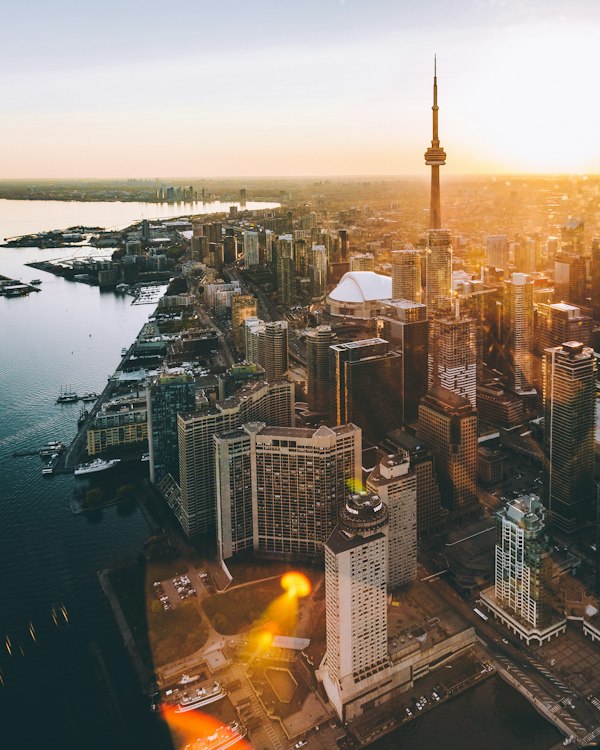
Toronto (population 6.2 million metro — Canada’s largest city, on the northwestern shore of Lake Ontario — the most culturally diverse city in the world by percentage of foreign-born residents, over 50% of the population born outside Canada — the Distillery District (the most intact Victorian industrial complex in North America — the former Gooderham and Worts Distillery (1832–1990) converted to a cobblestone arts and dining precinct — 44 heritage buildings on 13 acres), the CN Tower (553 metres, the world’s tallest free-standing structure 1976–2007 — the glass floor observation level at 342 metres and the EdgeWalk external platform at 356 metres), the St Lawrence Market (voted the world’s best food market by National Geographic in 2012 — the South Market building, open Tuesday–Sunday, the peameal bacon on a bun at Carousel Bakery — the definitive Toronto food)). Niagara Falls (130km southwest of Toronto — the three falls (Horseshoe Falls — the largest, on the Canadian side, 57 metres high and 790 metres wide, carrying 90% of the Niagara River’s flow — American Falls and Bridal Veil Falls on the US side) — the Maid of the Mist boat (operating since 1846, the boat that approaches the base of the Horseshoe Falls to within 20 metres — the spray sufficient to soak everyone despite the provided ponchos — the most visceral way to understand the falls’ volume — 168,000 m³ of water per minute at peak flow). Prince Edward Island and Nova Scotia: the Maritime provinces, PEI’s red-sand beaches and lobster, Nova Scotia’s Cape Breton Cabot Trail (the 298km loop drive around Cape Breton Island — consistently rated among the world’s finest coastal drives).

  • Niagara Horseshoe Falls — 168,000 m³/min · Maid of the Mist boat
  • Toronto Distillery District — 44 Victorian heritage buildings, 1832
  • CN Tower EdgeWalk — external walkway at 356m
  • St Lawrence Market — peameal bacon on a bun · voted world’s best food market
  • Cape Breton Cabot Trail — 298km Nova Scotia coastal loop
💡 INSIDER TIP — The Moraine Lake Road Problem & How to Fix It

Moraine Lake — the Valley of the Ten Peaks, the most photographed lake in Canada — is inaccessible to private vehicles from May through October. Parks Canada banned private cars in 2023 after gridlock and safety incidents. The authorised access methods are: the Parks Canada shuttle bus (reservation required at reservation.pc.gc.ca — opens 8 weeks before the access date, sells out within hours for July and August — book the exact moment reservations open), the Parks Canada bike share (cycling from Lake Louise Village, 11km, no reservation required but the road is steep in sections), or a guided tour operator (tour operators have reserved shuttle seats — the easiest solution if you missed the reservation window). The Moraine Lake Rockpile Trail (the 300-metre walk to the elevated rock pile at the lake’s northeast end, where all the “Valley of the Ten Peaks” photographs are taken) requires arriving at the lake by 7:30am to have the view without the crowd. The first shuttle departs Lake Louise Village at 6am. Be on it.

The Scale Problem — And Why It’s the Point

The single most common mistake in planning a Canada trip is attempting to “do Canada” in two weeks. Canada is 9.98 million km². Australia is 7.69 million km². Attempting to see Banff, Quebec City, Niagara Falls, Churchill, and the Yukon in a single trip is the equivalent of a Canadian visitor attempting to see the Kimberley, the Great Barrier Reef, the Snowy Mountains, and Tasmania in fourteen days. It is technically achievable. It is not the right way to experience any of them.

“Canada rewards the traveller who picks a region and surrenders to its specific weather, light, and wildlife window. The glacier lakes are only that colour for eight weeks. The polar bears are only on the tundra for six.”

The correct way to plan Canada is to choose one region per visit and go deep into it. Banff and the Icefields Parkway in summer (June–September) for the lakes. Churchill in October–November for polar bears. The Yukon in February–March for aurora. Quebec City in February for the Carnival. Each of these requires 4–7 days minimum, and each is made better — sometimes only made possible — by arriving at the right time of year. Canada’s wildest experiences are not improvements on human-made attractions. They are weather-dependent, season-dependent, and geographically remote. They are exactly what makes Canada worth the 20-hour flight from Brisbane.

9 Curated Experiences

Canada Tours from Brisbane

Season-specific, region-specific, specialist-guided — all bookable through Cooee Tours.

⛰ Banff · Summer
Banff & Icefields Parkway Summer Tour
⏱ 5 days★ 5.0(2,340 reviews)

The Banff summer circuit — June to September — when the glacial rock flour reaches its maximum concentration in suspension and the lakes are at their peak implausible turquoise. The tour departs Calgary (YYC — 90km east of Banff on the Trans-Canada Highway — the drive from Calgary airport to the park gate passes through the foothills transition from prairie to mountain with the Rockies’ first peaks visible 80km before arrival) and drives the entire 230km Icefields Parkway north to Jasper before returning south. Moraine Lake (Parks Canada shuttle pre-booked — the 6am first departure, the Rockpile Trail at 7am before the second shuttle arrives — the Valley of the Ten Peaks in the early light with the highest peaks catching the first sun while the valley floor is still in shadow — the specific visual the photograph cannot capture is the depth of the scene — the ten peaks arranged in an apparent flat frieze from the air become a 3D landscape from the rockpile). Lake Louise morning (the Victoria Glacier above, the canoe rental on the lake — paddling to the north shore places you directly below the glacier at the water level — 15 minutes from shore, the hotel disappears and the glacier fills the entire view). Athabasca Glacier walk (the 1992, 1982, and 1948 recession markers on the valley floor). Peyto Lake. Jasper overnight. Return via the Parkway second day for alternate stops (Bow Lake, Weeping Wall, Parker Ridge trail to the Saskatchewan Glacier view at 2,250m).

Includes
Calgary airport pick-upMoraine Lake shuttle pre-bookedIcefields Parkway full circuitAthabasca Glacier walk4 nights lodging
⛰ Banff · Winter
Banff & Lake Louise Winter Experience
⏱ 5 days★ 4.9(1,560 reviews)

Banff in winter (December–March) is the Rocky Mountain landscape in its most dramatically different form — the turquoise lakes are frozen and snow-covered (Lake Louise freezes to 90cm of ice by January — thick enough for the ice sculpture festival and speed skating circuits cut into its surface), the hot springs steam in the −25°C air, and the mountains are white above the dark pine treeline. The Fairmont Chateau Lake Louise in winter (the hotel at 100% availability compared to its fully booked summer status — the rooms overlooking the frozen lake and the Victoria Glacier are the finest winter lodge room view in Canada — book the lake-view rooms — the hotel’s ice bar on the frozen lake surface, operating from December, serves cocktails in glasses carved from lake ice). Skiing: Banff Sunshine Village (the highest base elevation of any Canadian ski resort — 1,660m — the snow is drier and lighter than coastal resorts — the longest ski season in Canada, November–May) and Lake Louise Ski Resort (the largest ski area in the Banff and Lake Louise region — 4,200 acres — the most photographically dramatic skiing in Canada, the Back Bowls running directly toward the lake visible below). Snowshoeing in Johnston Canyon (the canyon walls frozen into blue and white ice columns — the Upper Falls frozen solid — the most theatrical winter landscape accessible on foot in Banff). Dog sledding near Canmore. Banff hot springs (Cave and Basin — 38°C sulphur water — the outdoor pool in −15°C air with steam rising from the water surface — the most physically dramatic contrast available in a single outdoor experience in Canada).

Includes
Calgary airport pick-up4 nights Banff/Lake Louise lodgingJohnston Canyon ice walkHot springs entryDog sledding
🍄 Churchill · Oct–Nov
Churchill Polar Bear & Tundra Expedition
⏱ 5 days from Winnipeg★ 5.0(890 reviews)

The Churchill polar bear expedition — October and November only, the 6-week window when the western Hudson Bay polar bears congregate on the tundra waiting for sea ice — is the most completely compelling wildlife experience available to Australian travellers in the Western Hemisphere. It requires commitment: fly from Winnipeg (1.5 hours on Calm Air or Canadian North — the two airlines serving Churchill — the flight itself traverses the boreal forest to tundra transition, visually one of the most dramatic ecological shifts in North America — the forest simply stops, replaced by flat lichen-covered tundra with willow scrub) or take the Hudson Bay Railway (46 hours from Winnipeg — an extraordinary journey in its own right through subarctic wilderness, arriving at Churchill’s century-old station). The Tundra Buggy (the 1.5-metre tyre vehicle that moves through the tundra — polar bears investigate the vehicle from 2–3 metres — males up to 500kg, females with cubs of the year — the bears play-fight, sleep, and interact with each other in full view of the buggy passengers — the guide provides species biology, climate change context, and population data from the ongoing research program). The Tundra Buggy Lodge option (staying overnight on the tundra in the lodge vehicle, 40km from Churchill — the best weather access, the most aurora viewing opportunities, and the earliest morning bear encounters before the day-trip buggies arrive — this option sells out 12 months ahead; book as soon as dates are published). Churchill also offers boreal forest snowshoeing, aurora viewing over Hudson Bay (February–March), and the Northern Studies Centre for science interpretation.

Includes
Winnipeg return flightsChurchill hotel (4 nights)3 full-day Tundra Buggy toursNaturalist guideChurchill town orientation
🌟 Yukon · Winter Aurora
Yukon Northern Lights & Winter Wilderness
⏱ 6 days from Whitehorse★ 4.9(1,120 reviews)

The Yukon Northern Lights tour — February and March, the peak aurora months in the Yukon (geomagnetic activity higher in equinox months, nights long enough to provide 8–10 hours of darkness, and the snow-covered boreal forest providing the reflected foreground that makes aurora photographs memorable) — is the most complete combination of aurora viewing and winter wilderness activity available in Canada. Whitehorse (accessible by Air Canada from Vancouver in 2.5 hours — direct from Australian gateway airports via Vancouver — the Yukon River frozen to 1.5–2 metres of ice, dog sled teams crossing the river at road-crossings in the city) is the base. The aurora viewing program uses a remote cabin 30km outside Whitehorse (the city’s modest light pollution is absent — the Yukon River valley provides a full 360-degree dark horizon — the guide monitors the Space Weather Prediction Center’s Kp index in real time and alerts guests when activity begins — the sequence of a Kp5–6 aurora event: faint green arc appears on the northern horizon — brightens and develops structure (rays, bands) — if Kp exceeds 6, the entire sky becomes active, the colours shift from green to magenta and white at the edges, the movement is observable with the naked eye in real time — a Kp8 event, the strongest the Yukon sees in a normal winter, fills the sky from zenith to horizon). Day activities: dog sledding on the Yukon River ice (the team of 8–10 Alaskan huskies, the guide teaches mushing technique — the dogs run at 20–25km/h on good conditions), snowshoeing in the boreal forest (the Yukon’s lodgepole pine and white spruce forest, the moose tracks in the snow, the Canada jay landing on the outstretched hand for trail mix), snowmobile excursions, and ice fishing.

Includes
Whitehorse lodging (5 nights)Aurora cabin viewing 3 nightsDog sledding on Yukon River iceSnowshoe boreal forestKp alert & realtime aurora guide
🏛 Quebec · French Canada
Quebec City & Montreal Cultural Tour
⏱ 6 days★ 4.9(1,780 reviews)

The French Canada circuit — Quebec City and Montreal, the two cities that provide the most complete cultural contrast to the Anglophone North American experience — connected by VIA Rail’s 3.5-hour train service on the Quebec City–Windsor corridor, the most used railway line in Canada. Quebec City (3 nights — the Vieux-Québec UNESCO World Heritage walking circuit — the Château Frontenac at night (the illuminated hotel visible from anywhere in the Lower Town — the most atmospheric hotel approach in North America: the Funicular from Rue du Petit Champlain, the Dufferin Terrace promenade, the hotel’s bar in winter), the Quartier Petit Champlain (the narrow 17th-century lower town street, the Rue Saint-Paul antique galleries, the trompe l’oeil murals), the Montmorency Falls (30 metres higher than Niagara — 83 metres total — 10km east of Quebec City — accessible via footbridge directly over the crest of the falls — the winter icecone at the falls base, which builds through December and January to a 30-metre cone of frozen spray, is one of the most unusual natural formations in eastern Canada — ice climbing on the cone is offered by local guides). Montreal (3 nights — Old Montreal cobblestone circuit, the Notre-Dame Basilica (the 19th-century Gothic Revival interior — the stained glass tells the Montreal story rather than Biblical narrative — the AURA light show 5 nights per week — the finest immersive light installation in a heritage building in North America), the Plateau-Mont-Royal neighbourhood (the most densely restaurant-populated neighbourhood per block in North America — Mile End for the bagel debate and Schwartz’s Deli for the Montreal smoked meat (the 72-hour cured and steam-cooked brisket on rye with mustard — the queue outside Schwartz’s at 574 Boulevard Saint-Laurent is a permanent feature of Montreal geography))).

Includes
3 nights Quebec City3 nights MontrealVIA Rail Quebec–MontrealVieux-Québec guided walkNotre-Dame Basilica & AURA
🐋 Churchill · July Belugas
Churchill Beluga Whale Summer Experience
⏱ 4 days from Winnipeg★ 5.0(680 reviews)

July at Churchill presents an entirely different wildlife spectacle from the October polar bear season: the Churchill River estuary receives 3,000–4,000 beluga whales (Delphinapterus leucas — the “canaries of the sea” — named for their extraordinary vocalisation repertoire, the most acoustically complex of any cetacean species — clicks, whistles, chirps, and moans audible through the hull of a boat or through a snorkel mask — young calves the grey of a thundercloud, adults the white of sea ice). The beluga aggregation uses the Churchill River estuary for three reasons: the water temperature (warmer than Hudson Bay — important for calves in their first summer), the food availability (Arctic cod and capelin), and the shallow rubbing beaches (the belugas rub on the river bottom to shed their moulting skin — behaviour visible in 1–3 metres of water from a kayak or stand-up paddleboard). The kayaking experience (paddling among the beluga pod — the animals are deeply curious about the kayaks, approaching to within touching distance and vocalising — snorkelling in a drysuit provides the acoustic experience — the sound field of 50+ belugas vocalising simultaneously at 1 metre distance is entirely unlike any other wildlife encounter available to an Australian traveller anywhere in the world — it is the most unexpected natural sound on Earth for anyone who has not heard it). Caribou and Arctic fox are also present in July on the Churchill tundra. The boreal forest wildflower display (the sub-Arctic summer is intense — 20 hours of daylight in July — the wildflowers bloom and seed in 6–8 weeks, producing carpets of fireweed, Labrador tea, and Arctic poppy visible from the Tundra Buggy road).

Includes
Winnipeg return flightsChurchill hotel (3 nights)Beluga kayaking & snorkellingDrysuit hireTundra wildflower walk
🌎 BC · Pacific Coast
Vancouver, Whistler & Vancouver Island
⏱ 7 days★ 4.9(2,230 reviews)

The British Columbia circuit — the most climate-varied, geographically diverse, and year-round accessible region of Canada — starting at YVR (Vancouver International Airport, 25 minutes from downtown by SkyTrain). Vancouver (2 nights — Stanley Park seawall walk (8.8km, old-growth Douglas fir, the totem poles of Brockton Point — the nine poles include Haida, Kwakwaka’wakw, and Squamish Nations works, the guide explains each nation’s tradition in context — this is not a general “totem pole” stop but a specific introduction to the Northwest Coast Indigenous art traditions), Granville Island Public Market (the finest food market in Western Canada — the fresh BC salmon, the Dungeness crab, the Okanagan peaches in summer — the market building is on a former industrial island under the Granville Bridge, the concrete columns of the bridge forming the market’s northern wall — the most atmospheric market building in Canada), Gastown (the original Vancouver settlement of 1867, the steam clock on Water Street (built 1977 — runs on city steam pressure — whistles every 15 minutes — the most-photographed clock in Canada), the restaurant scene on Blood Alley). Sea to Sky Highway to Whistler (3 nights — summer: mountain biking, Peak 2 Peak Gondola, glacier snowcoach, hiking; winter: Whistler Blackcomb skiing, the North America’s best powder snow resort by most metrics). BC Ferries to Victoria (1.5 hours) — Butchart Gardens (the 22-hectare private garden in a reclaimed limestone quarry — the Sunken Garden, the Italian Garden, the Saturday night fireworks July–August) and inner harbour walk.

Includes
Vancouver hotel 2 nightsStanley Park guided walkSea to Sky drive to WhistlerWhistler 3 nightsVictoria & Butchart Gardens
🏛 Toronto · Ontario
Toronto, Niagara Falls & Ontario Highlights
⏱ 5 days★ 4.8(1,890 reviews)

The Ontario circuit — Canada’s most visited region by international travellers — combining Toronto (Canada’s largest city), Niagara Falls (Canada’s most visited natural attraction), and the Niagara wine region and Prince Edward County (Ontario’s emerging wine and food destination). Toronto (2 nights — the Distillery District walking tour (the 44 Victorian heritage buildings, the redbrick laneways, the resident galleries and the seasonal Christmas Market — the finest Christmas market in Canada, December — open-air, cobblestone, the horse-drawn carriages, the mulled wine from the cask at the market entrance), the CN Tower (the EdgeWalk external walkway at 356m — harness-attached, the lake visible 50km north and the US shore of Lake Ontario visible to the south — Toronto is, counterintuitively, south of Seattle), Kensington Market (the most multicultural urban neighbourhood in North America — the Portuguese fishmongers, the West Indian roti shops, the vintage clothing stores, the outdoor bars on the lane behind the market)). Niagara Falls (1 day — the Maid of the Mist (the boat that goes to the base of Horseshoe Falls — 168,000 m³/minute — the poncho inadequacy — the water is louder than expected), the Journey Behind the Falls (the tunnels cut through the bedrock behind the Canadian Falls, looking out through the water curtain — the most disorienting perspective on Niagara available)). Niagara wine region (the Icewine capital of the world — Inniskillin Winery, the most internationally awarded Icewine producer — the Vidal Blanc grapes left on the vine until −8°C concentrates the juice by freezing the water content — the resulting wine is dessert-level sweet, 35–45 Brix, 10–11% alcohol — half a bottle serves 8 people — the most Canadian wine produced anywhere).

Includes
Toronto hotel 3 nightsDistillery District guided walkMaid of the MistJourney Behind the FallsInniskillin Icewine tasting
🇨🇦 Canada · 14-Day Package
Essential Canada 14-Day West to East
⏱ 14 days / 13 nights★ 5.0(560 reviews)

The Essential Canada 14-Day package — the minimum viable West-to-East circuit for a first-time Canadian visitor — designed around the reality that most Australians visit Canada once, have two weeks, and want to cover the country’s greatest hits without spending the entire trip on an airplane. The package runs Vancouver (entry) to Montreal (exit): 3 nights Vancouver (Stanley Park, Granville Island, Sea to Sky day drive), fly to Calgary (Banff 5 nights — Moraine Lake, Lake Louise, Icefields Parkway, Johnston Canyon, Banff hot springs, elk on the main street at dusk), fly to Toronto (2 nights — Distillery District, CN Tower, Kensington Market), Niagara Falls day trip, VIA Rail Toronto–Montreal (5.5 hours, the most scenic train route in Central Canada — the northern shore of Lake Ontario through Kingston, Cobourg, and Oshawa), Montreal (2 nights — Old Montreal, Notre-Dame Basilica AURA show, Schwartz’s smoked meat, St Viateur bagels). All internal flights, VIA Rail, hotels, and guided tours in each city are included. The Churchill polar bear or Yukon aurora extension can be added to either end of this package for additional cost. The 14-day package deliberately omits Churchill and the Yukon — both require a dedicated 4–7 day trip and a specific seasonal window that rarely aligns with a first-time Western–Eastern Canada circuit.

Includes
13 nights lodgingInternal flights YVR–YYC, YYZ–YULVIA Rail Toronto–MontrealCity guides all regionsMoraine Lake shuttle pre-booked
Four Seasons — Four Canadas

When to Visit Canada

Canada’s four seasons are genuinely distinct — not gradients but separate experiences. The correct season depends entirely on which Canada you want.

Winter
December – March

The most extreme and most rewarding season. −25°C in Banff, −30°C in the Yukon, −15°C in Churchill. The aurora borealis at peak (February–March). The Chateau Frontenac at its most dramatic (snow-covered, fully available, winter fireplaces). Skiing at Banff Sunshine and Whistler Blackcomb at their best powder conditions. Johnston Canyon frozen. The Quebec City Carnaval (February). Dog sledding on the Yukon River. If you dress correctly, Canadian winter is the finest season in the country — the crowds are absent, the prices are lower (outside ski resorts), and the landscapes are transformed. Clothing requirement: serious cold weather gear is not negotiable.

🌸
Spring
April – May

The transitional season — the most variable in quality. The Rockies’ lakes are still ice-covered until May (Lake Louise typically clears in mid-May, Moraine Lake late May–early June). Bear and wildlife activity increases as the animals emerge from hibernation. Wildflowers bloom in the BC coastal regions (Butchart Gardens at peak). The Great Bear Rainforest on BC’s central coast: grizzly bears feeding on eulachon fish runs in river estuaries April–May. Prairie Canada (the spring canola bloom — the yellow fields of Alberta and Saskatchewan in May are visible from aircraft as a continuous wash of yellow across the landscape). Fewer tourists, lower prices, and the specific energy of a landscape emerging from winter.

Summer
June – September

Peak season — the turquoise lakes at their most vivid (mid-July to mid-August, rock flour concentration at maximum), the Icefields Parkway fully accessible, the Moraine Lake shuttle operating, Vancouver at its sunniest (20–25°C, 16 hours of daylight), and Churchill’s beluga whales in the estuary (July). Also the most crowded season in Banff (Lake Louise and Moraine Lake require shuttle bookings months ahead) and the most expensive. Book accommodation in Banff 6–12 months ahead for July and August. The west coast BC summer (salmon season in the rivers August–October, orca in the Salish Sea July–October) is the finest wildlife season in British Columbia. The midnight sun in the Yukon (20+ hours of daylight in late June).

🍃
Autumn
October – November

Canada’s most photogenic season — and the polar bear season. The eastern Canada fall foliage (the maple, birch, and aspen canopy of Quebec, Ontario, and New Brunswick turning red, orange, and gold — the Laurentian Mountains north of Montreal in October, the Cabot Trail in Cape Breton in late September, PEI’s red soil and yellow maples — the most saturated natural colour display available in a temperate country outside Japan’s autumn). Churchill polar bears from mid-October. The larch season in Banff (the larch trees on the Larch Valley Trail above Moraine Lake turn a brilliant gold in late September — the only coniferous trees in the Rockies that change colour in autumn — the yellow larch against the turquoise lake and white peaks is the most specific visual combination available in Canadian nature photography). Fewer crowds than summer, lower prices, and the aurora season beginning in earnest.

Before You Go

Planning Your Canada Trip

Getting to Canada
Brisbane to Vancouver: Air Canada via Los Angeles (~20hrs total), Qantas via Los Angeles (~19hrs), or via Hong Kong. Air Canada operates a direct Sydney–Vancouver service (~15hrs, the most direct Australia–Canada routing available). Toronto is accessible from Sydney via Los Angeles (17–20hrs). The eTA (Electronic Travel Authorisation — CAD$7 at canada.ca/eta) must be obtained before check-in — it is linked to your passport electronically and checked at check-in rather than at the Canadian border. Apply at least 72 hours before departure.
Cold Weather Preparation
Canadian winter requires a specific clothing system — not simply “warm clothes.” Base layer: merino wool or synthetic moisture-wicking (not cotton — cotton retains moisture and conducts heat away from the body — in −25°C conditions, wet cotton causes hypothermia). Mid layer: 300-weight fleece or down jacket. Outer shell: windproof and waterproof. Head: wool beanie covering the ears or a balaclava — 40% of body heat is lost from the uncovered head. Hands: liner gloves inside outer mitts. Feet: merino wool socks inside insulated boots rated to −40°C. All of this can be purchased in Canada before travelling north, but at significant cost — bring it from home.
🚗
Getting Around Canada
Canada’s domestic aviation network is comprehensive and the fastest way to cover distances. Air Canada and WestJet connect all major cities. Hire car: essential in Banff and British Columbia outside Vancouver. Drive on the right — IDP required alongside Australian licence. VIA Rail connects Toronto–Montreal (5.5hrs), Toronto–Ottawa (4hrs), and operates the transcontinental Canadian (Toronto–Vancouver, 4 nights). Uber operates in all major Canadian cities. In Banff National Park, Parks Canada shuttles replace hire cars for Moraine Lake and Lake Louise in peak summer.
🚩
Indigenous Culture Protocols
Canada’s Indigenous (First Nations, Métis, and Inuit) cultures are central to the country’s identity and its most distinctive tourism experiences. In Churchill, the Cree and Dene nations’ relationship to the land and the polar bear population is fundamental context. In Vancouver, the totem poles of Stanley Park belong to specific nations with specific protocols. Ask before photographing ceremony, cultural objects, or sacred sites. Seek Indigenous-guided tours (far more contextually accurate than non-Indigenous guides explaining Indigenous culture). In Canada, the land acknowledgement — recognising the Traditional Territory on which any activity takes place — is a standard practice at all public and tourism events.
Day by Day

Canada Itineraries

Three circuits — designed around the principle that Canada rewards regional depth over cross-country breadth.

⌛ 7 Days · Canadian Rockies
The Rockies — Banff to Jasper
Lakes · Glaciers · Wildlife · Mountain Air
Day 1
Arrive Calgary (YYC). Hire car from airport. Drive Trans-Canada to Banff (90 min). Check in Banff town. Banff Avenue evening walk (elk on the main street at dusk — a routine Banff experience — the elk are wild and will charge if approached — maintain 30m distance). Banff Springs Hotel dinner (the 1888 castle-style hotel above the Bow River — the dining room is open to non-guests).
Day 2
Moraine Lake + Lake Louise. Parks Canada shuttle from Lake Louise Village 6am (booked weeks ahead at reservation.pc.gc.ca). Rockpile Trail 7am (the Valley of the Ten Peaks before the second shuttle). Lake Louise canoe rental 10am (30 minutes to the glacier). Fairmont Chateau Lake Louise lunch terrace.
Day 3
Icefields Parkway north. Bow Lake (dawn reflection, most mirror-calm 6–8am). Peyto Lake viewpoint (20-minute walk — the brightest turquoise of all Rockies lakes). Athabasca Glacier walk (the 1992, 1982, 1948 recession markers — allow 2 hours). Columbia Icefield Discovery Centre. Arrive Jasper 5pm.
Day 4
Jasper day. Maligne Canyon ice walk in winter (the most theatrical canyon in the Rockies, 55-metre walls) or Maligne Lake canoe in summer (the Spirit Island kayak circuit — the most photographed inland water scene in Canada). Mount Edith Cavell (the Angel Glacier hanging above the tarn — accessible July–September). Jasper townsite wildlife walk (moose, black bear, and mountain goat are all regularly seen around Jasper in early morning).
Days 5–6
Return south via Icefields Parkway (2nd day). Parker Ridge Trail (the 2.4km return trail to the Saskatchewan Glacier overview at 2,250m — 2 hours, Grade 2, the most dramatic single viewpoint accessible on foot on the Parkway). Sunwapta Falls. Weeping Wall (winter: a 100m frozen waterfall climbed by ice climbers — the most dramatic roadside winter scene on the Parkway). Johnston Canyon in winter or summer. Banff hot springs.
Day 7
Banff — Calgary — depart. Banff Gondola morning (the summit view of the Bow Valley and the town 700m below — grizzly bears regularly visible on the slopes from the gondola in summer). Drive Calgary YYC. Depart.
Book This Itinerary →
⌛ 10 Days · West Coast & Rockies
Vancouver, Whistler & Banff
Ocean · Mountains · Forest · Glacier
Days 1–3
Vancouver. Day 1: Arrive YVR, SkyTrain to downtown (25min), Granville Island Market afternoon. Day 2: Stanley Park seawall walk (morning — 8.8km, 2.5 hours, totem poles at Brockton Point), Gastown steam clock, Chinatown Dr Sun Yat-Sen garden. Day 3: Sea to Sky Highway to Squamish (Shannon Falls, Stawamus Chief viewpoint — the 700m granite monolith — the Squamish Gondola above the tree line). Return Vancouver.
Days 4–5
Whistler. Drive Sea to Sky Highway (1.5hrs from Vancouver — Howe Sound fjord views). Days 4–5: Peak 2 Peak Gondola (3S-technology gondola crossing the 4.4km valley between Whistler and Blackcomb mountains at 436m above the valley floor — the longest unsupported span of any gondola in the world). Summer: mountain bike, hike, Scandinave Spa. Winter: ski Whistler Blackcomb (8,171 acres).
Day 6
Fly Vancouver–Calgary. Air Canada (1hr 15min). Drive Banff (90min). Afternoon: Banff townsite, Bow River walk, elk patrol at dusk.
Days 7–9
Banff & Icefields Parkway. Day 7: Moraine Lake (6am shuttle) + Lake Louise canoe. Day 8: Icefields Parkway — Peyto Lake, Athabasca Glacier, Jasper overnight. Day 9: Maligne Canyon or Lake, return Banff via Parkway (Parker Ridge Trail).
Day 10
Banff — Calgary — depart. Banff hot springs morning (Cave and Basin — the steam in cold air). Drive Calgary YYC. Depart. The flight home is roughly 19–20 hours — the Rocky Mountain photos will keep you busy for at least three of them.
Book This Itinerary →
⌛ Wildlife Season Add-On
Churchill — Polar Bears or Belugas
Most Spectacular Wildlife · Tundra · Arctic
Planning
This itinerary is an add-on to any Canada circuit. Churchill can be bolted onto the beginning or end of a Banff or Eastern Canada trip via Winnipeg (fly into Winnipeg from anywhere in Canada — 1.5hrs from Calgary, 2hrs from Toronto). The polar bear season (October–November) and beluga season (July) are discrete windows that do not overlap with each other or with the Banff summer peak — choose one per trip.
Day 1
Winnipeg to Churchill. Fly Winnipeg–Churchill (Calm Air or Canadian North, 1.5hrs). Hotel check-in. Churchill orientation walk (polar bear alert signs, the rocket research range — the Churchill Rocket Research Range operated from 1957 to 1985, 3,000 rockets launched from the tundra for upper atmosphere research — the launch complex still visible 5km from town). Evening aurora briefing (October–November) or estuary overview (July).
Days 2–4
Tundra Buggy days (polar bear season). Full-day Tundra Buggy tours (6am–5pm — 8–10 bears typically encountered — the guides explain the population dynamics, climate change impacts on sea ice formation timing, and individual bear identification). The wait at the buggy is part of the experience — the bears approach on their own timeline. OR July: Beluga kayaking (3 sessions — morning, afternoon, evening — the evening session in midnight sun with the Hudson Bay flat and gold).
Day 5
Churchill — Winnipeg — connect onward. Fly back to Winnipeg. Connect to Calgary or Toronto for the onward Canada circuit, or fly home via Toronto. The Churchill experience needs a full day of recovery — the tundra cold (October — −10 to −20°C) is physically exhausting, not because it is dangerous in a Buggy but because the exposure to cold air over 9 hours depletes core temperature reserves that a hotel room and a large meal restore slowly.
Add Churchill to My Canada Trip →

Standing two metres from
a 500-kilogram polar bear
on the Churchill tundra.

Our Canada specialists have the Moraine Lake Parks Canada shuttle reserved for the 6am departure — the one that gets you to the Rockpile before the second wave arrives — the Churchill Tundra Buggy booked with the operator whose guide has been photographing the same bears for 15 years, and the Yukon aurora cabin positioned in the Yukon River valley where the light pollution is zero and the forecast is checked every 20 minutes. They know which Parks Canada shuttle sells out first, which month the Banff larches turn gold, and why the Churchill beluga snorkel at 10pm in the July midnight sun sounds impossible and is not. Twenty hours from Brisbane. Let us build your Canada.

Plan My Canada Trip → Call 0409 661 342

50,000+ Australian travellers · ATAS Accredited · 35+ Years